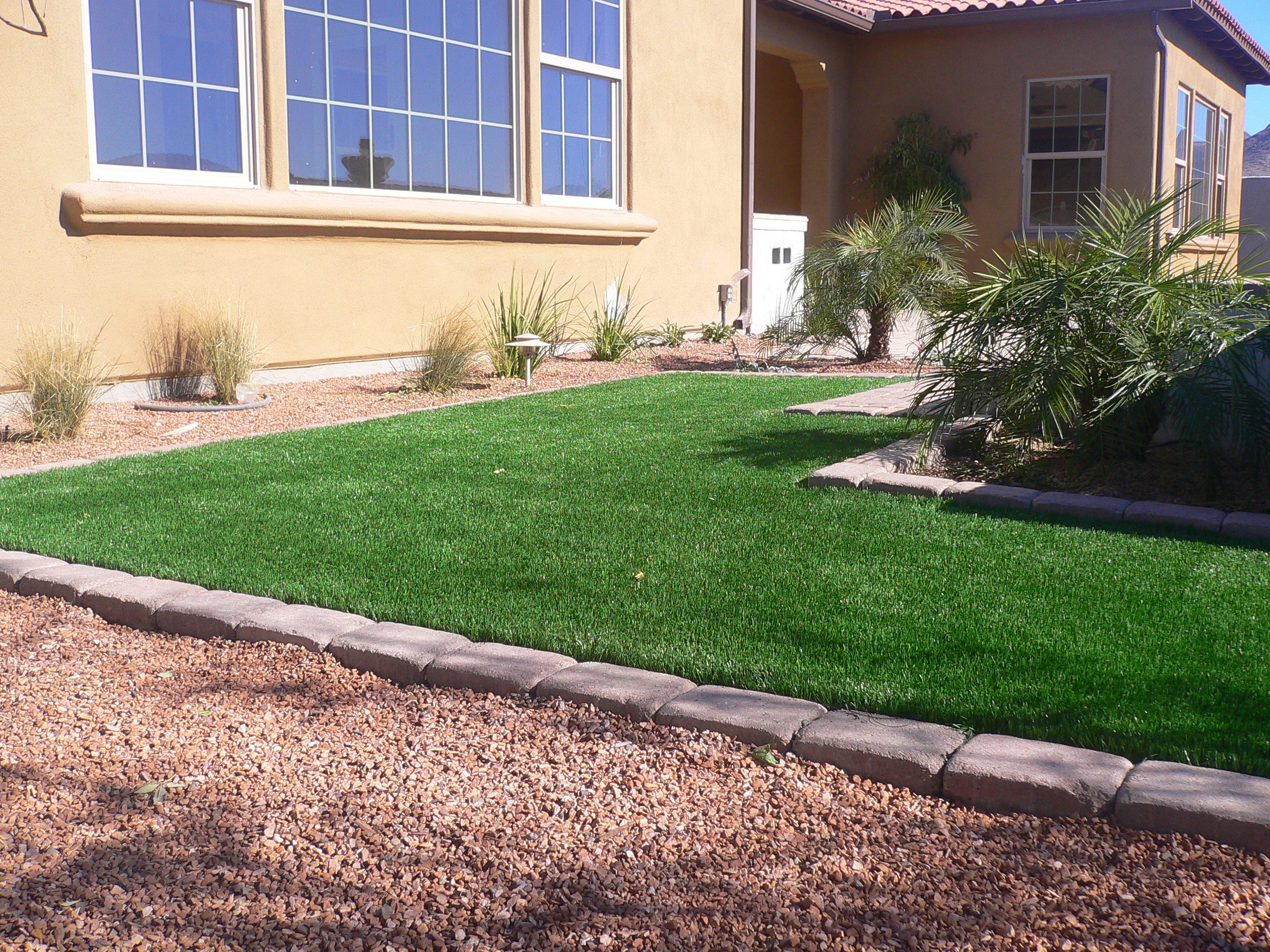
I have spent 17 years installing and managing artificial turf projects in Arizona, and there is one photo I get sent more than any other. A green surface with one ugly crinkled section, usually a couple feet wide, usually running along one side. Some weeks it comes from a homeowner looking at a backyard. Other weeks it is a property manager looking at a courtyard, or a school looking at a play area. The message is almost always some version of the same thing: "I don't know what's going on with my grass."
Here is what is going on. You almost certainly got sound turf. What you got along with it is something nearby doing what nobody warned you about, and most often that is a window. That holds whether it is a backyard, an HOA courtyard, a school play area or an office entry, and on commercial sites it is usually worse, because there is simply more glass. And if you are reading this before you have put anything down, you are in the best spot of anyone here, because this is far less expensive to design around than it is to repair.
What is actually happening out there
Go stand where the turf is, or where it is going, and turn around slowly. You are not looking at the grass. You are looking at what surrounds it: your own windows, a neighbor's second story, a building across the street, a glass railing, anything polished. It does not have to be a big window. A small pane focuses just as tightly as a wall of glass. Then go back out at the hour the sun is actually on that glass. Which hour that is depends on which way it faces. East does its work in the morning, south around midday, west late in the day. What you are looking for is a bright line moving across the ground.
That line is the reflection, and it shows up long before any damage does. If you can see it now, you can plan around it now.
The cause is the same every time. Something nearby is concentrating sunlight onto one piece of ground. Any window can do it. So can a glass door, a parked vehicle, a chrome railing, a mirror on a wall, a pool float, a water bottle left out on the lawn. A flat surface scatters light and does no harm. Anything with a curve to it does not scatter. It focuses.
Curved and shiny works like a magnifying mirror. Curved and clear works like a lens, which is why the clear pool floats do as much damage as the shiny ones. Either way, sunlight that was spread across a wide surface arrives on the grass concentrated into a small bright shape that moves. Windows are the most common source here, and energy efficient Low-E glass is the most common window. It carries a microscopic coating that bounces radiant heat back out, which is why your electric bill is lower than it would be otherwise. A pane that is even slightly bowed, and most of them flex a little under Arizona temperature swings, sends that heat back focused instead of scattered. That is the usual story. It is not the only one.
How hot does the reflection actually get? Industry reporting on reflective burn puts focused heat as high as 200 degrees Fahrenheit. That is on a surface that is already sitting in full Arizona sun.
Why is it one section instead of general damage? Because a focused reflection is a shape, and that shape travels. It moves across the ground through the day and shifts through the season as the sun angle changes, so it works the same ground over and over. Heat damage from a window tracks the sun. Ordinary wear does not.
Is it covered under warranty? Usually not, and this is the part that stings. Most turf warranties exclude damage from reflected or concentrated heat, because it is an external cause, not a defect in the product. Read yours before you call anybody.
Does it get worse? Yes. Once fibers distort they do not stand back up, and the same reflection comes back at the same hour. It does not heal.
Can it be fixed without redoing the lawn? Often, yes. That is usually the conversation we end up having.
I have not installed yet. Does this change what I should buy? It can, and this is the least expensive moment to deal with it. If there is a window or anything reflective facing that space, the answer is usually nylon in that section and polyethylene across everything else, decided before anything goes down instead of after.
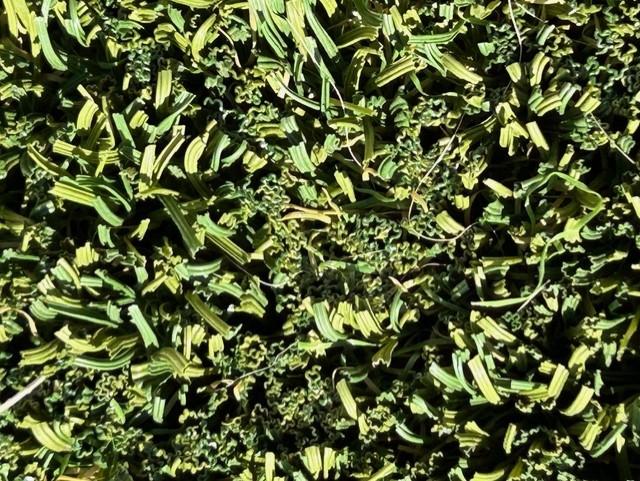
This is what it looks like up close. The blades curl in on themselves and glaze over, and once they do that they do not stand back up. Arizona Turf Masters job photo.
The fiber is the whole story
Nearly all landscape turf sold in Arizona is polyethylene. There is a good reason for that. It is the softest of the turf fibers, it looks the most like real grass, and for the large majority of yards it is the right call. We install a lot of it, and nothing here is meant to talk you out of it.
But polyethylene has a melting point, and a focused reflection off a window can get close enough to it to distort the blades. That is the mechanism. It is not a quality problem and it is not something a better polyethylene fixes.
Nylon is a different material with a different number. Published fiber data puts nylon's melting point well over 400 degrees Fahrenheit. Nylon 6 sits around 428, nylon 6,6 around 509, so the exact number depends on which one your product uses. Set either against a reflection topping out around 200 and the math stops being interesting. The window can throw everything it has and the fiber does not care.
One honest caveat, because I would rather you hear it from me. A published melting point describes the raw fiber, not the finished lawn. Real turf is blades plus backing plus everything holding it together, and a material can soften and distort before it ever reaches the melting number. So treat the fiber as the reason nylon belongs in a reflection zone, not as a promise about the whole product. When we quote your job I will show you the actual product data for what is going in your yard.
That is why we keep nylon in the lineup even though it is the priciest fiber on the truck.
The other place this bites: play areas
Playground and play surfaces are where we see this most often after backyards, and they get hit from two directions at once.
Play areas tend to get tucked against the building, which is exactly where the glass is. They also take the hardest, most concentrated traffic of any turf on a property. Kids do not distribute their wear evenly. They run the same line to the same slide a thousand times.
So you have the one surface that is most likely to be sitting in a reflection line and also most likely to be crushed flat in the same spots. Polyethylene will show both. Nylon is the most resilient of the turf fibers, meaning it stands back up after it is compressed instead of laying over, and it is not bothered by the reflection. On a play surface in Arizona that combination is worth paying for.
It is not always your own window
This is the part that surprises people, so I want to name a few culprits that do not live on your own house.
A commercial or multifamily building across from you. We get called to HOA courtyards and office entries for this as often as backyards now, and those sites are harder because there is more glass. A courtyard ringed by units catches reflections from several directions, and the pane doing the damage is frequently on an upper floor, so the burn sits in the common area turf while the source is three stories up. If you sit on a board or manage a property, that damaged section by the entry is worth a look upward before anyone blames the installer.
The neighbor's upstairs window. Reflected light does not stop at a property line. On a two story home next door, an upstairs pane can throw a reflection across the gap and down into your yard, and the homeowner standing in that yard has no idea where it is coming from because they are looking at their own walls. When we walk a property we look up and around, not just at the wall closest to the grass.
And plenty of it never involves a window at all. Here is what we have actually pulled up and replaced, grouped by what caused it, because the cause is what decides whether it happens again.
Something focused the sun into one spot.
- A neighbor's upstairs window, or a commercial building across the street
- Pool floats and beach balls left on the grass, clear ones as much as shiny ones, because a curved clear surface focuses light the same way
- Polished metal. A chrome patio piece, a sculpture, the edge of a metal table
- A decorative mirror on a wall
- Clear plastic and glass left in the sun. A water bottle or a glass tabletop is a lens when it is curved
- A parked vehicle, off the windshield or the chrome
Something hot touched it, or burned next to it.
- Fire pits and grills
- Fireworks
- Dropped coals and cigarettes
- Hot equipment set down on the lawn. A trimmer or a mower muffler does it in about two minutes
- A vehicle parked on turf, or exhaust pointed at it
- Boiling water poured on weeds. People do it because it works on pavers. It does not work here
Contact damage does not look like reflection damage. Something hot leaves char and ash behind. A reflection never leaves either one. It just curls the blades.
That list is not meant to talk you out of using your yard. Give the floaties a shaded place to live when the swimming is done, keep fire features on stone or pavers and respect the clearances the manufacturer lists, and you have handled most of it.
The common thread is that the surface is durable, not indestructible, and almost every failure we get called out to look at traces back to one specific source. Find the source and the fix gets simple.
Now the part I want to be straight with you about, because I would rather say it here than have it come up later. We look for reflection risk when we walk a yard, and we cannot promise we will catch it. A reflection lives at a certain sun angle on a certain day in a certain season. It may not be happening the morning we are standing there. It can also arrive months later because a neighbor put in new windows. So heat damage from reflected or concentrated sun is not something we can take responsibility for, and our service agreement says so in plain terms. Anybody who guarantees you otherwise is writing a check the sun gets to cash. What I can do is tell you what I see, put the right fiber where the risk is, and be honest about the rest.
Three things I tell people before they buy it
Heat is real, and it is workable. Every synthetic lawn in Arizona warms up in the summer, mine included, and I am not going to tell you otherwise. What I will tell you is that heat is the part we design around. Nylon's melting point is a durability number, not a comfort number, so we pair it with the cooling side of the build. Cooling infill like HydroChill uses moisture to bring the surface down. Lighter reflective fiber helps. Shade helps the most, and a rinse on a brutal afternoon does more than people think. When we walk your yard we will tell you which of those actually fit it.
Nylon has more backbone. It is stiffer than polyethylene, and that stiffness is the whole reason it springs back instead of laying flat. Same property, two names. On a play area or a traffic lane that is exactly what you want. On a lawn where your family stretches out on a spring evening, polyethylene feels better, and I will tell you to go that direction.
Nylon is the premium fiber. Which is why we almost never put it across a whole yard. The move that actually makes sense is nylon where the demand is and polyethylene everywhere else. Done well it reads as one continuous surface, and you have solved the problem without paying premium pricing across two thousand square feet.
What you can actually do about it
Take a photo when the glare is actually on the grass, with the window in the frame. That one image usually tells me everything: where the reflection lands, how wide that line is, and whether the damage matches it.
Then the options are roughly these. You can break the reflection, with exterior screens, awnings, or something tall enough to shade the pane. Film on the glass is on that list too, with one warning: do not assume any film is safe for your windows. Some manufacturers, Andersen among them, say applying reflective or decorative film to their glass can trap heat and raise the risk of cracking the pane. Check with the window maker and a real glass professional before anybody puts film on a window you paid good money for. You can change what sits in that section, which means nylon turf, or hardscape if that section was never doing much for you anyway. Or you can leave it, which is a real choice if the section lands somewhere nobody looks.
What I would not do is replace the same polyethylene in the same spot and hope. That is how people end up paying for the same repair twice.
If there is a burn line in your yard or on a property you manage, send a picture with the window in it and I will tell you what I think before anybody drives out. If you are planning turf and you are not sure whether you have a reflection problem, photograph the space and the glass around it and I will tell you that too. Either way the advice is free and it comes with no expectation. Reach us at azturfmasters.com/contact or call (480) 751-4343. One point of contact from the estimate through the last day of the install.
And if you just want to feel the difference between nylon and polyethylene for yourself, ask us to mail you free samples. No estimate required, no charge, and nobody has to come to your house.
Arizona Turf Masters has been installing synthetic turf across the Valley and Tucson since 2006. AZ ROC 234276, licensed, bonded and insured. Installed pricing runs $6.00 to $12.00 per square foot installed, and minimums do apply.