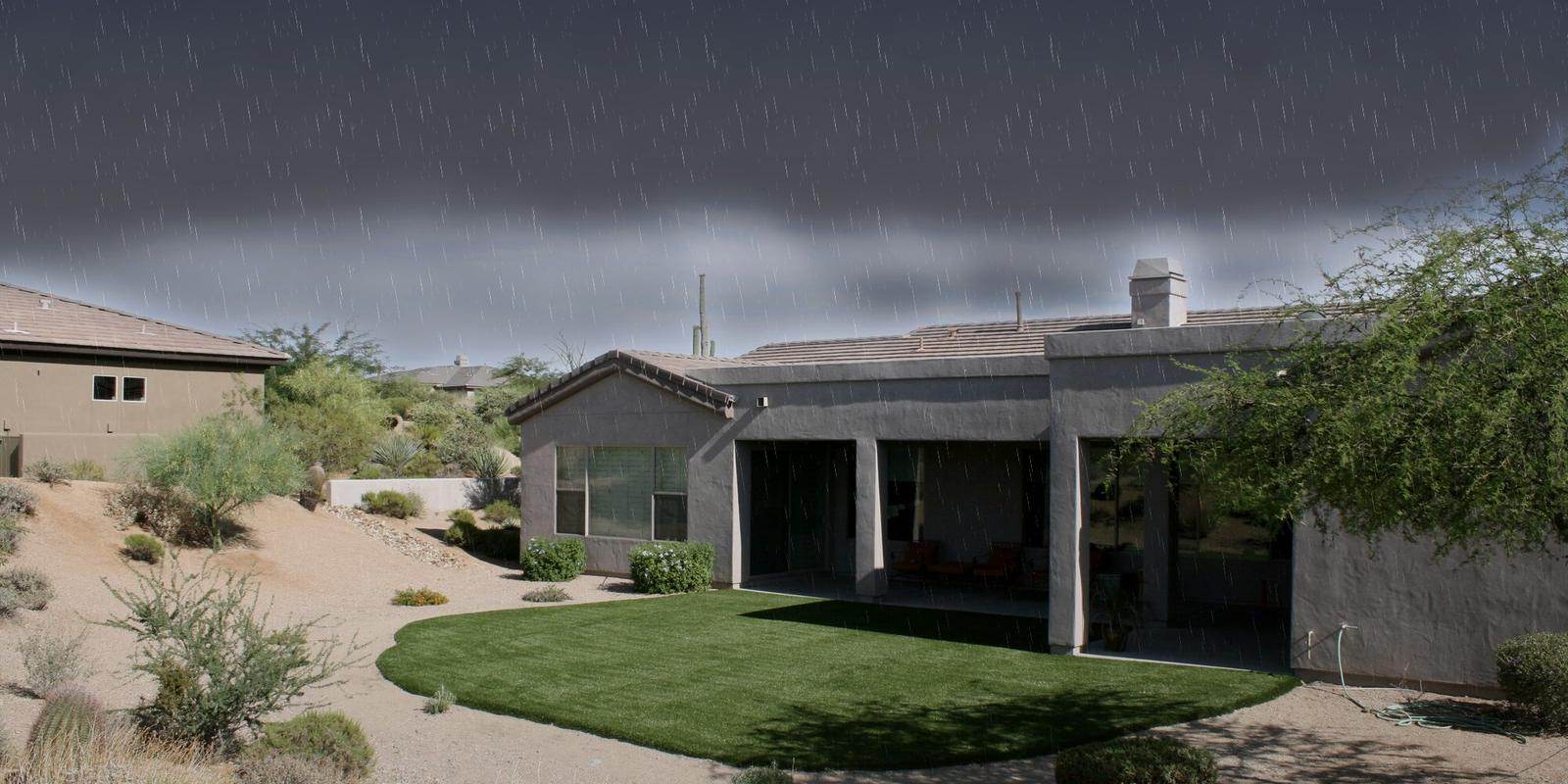
I have spent 17 years installing and managing artificial turf projects, and Arizona Turf Masters has served the Valley since 2006. Seventeen monsoon seasons in, I can tell you that a real storm is the most honest inspector your yard will ever get.
Every July and August my phone does the same two things. A storm rolls through the Valley, and the next morning I get photos. Some of them are homeowners showing off: their turf took a hard downpour and by lunch it was dry and green while the neighbor's Bermuda was a mud pit. The rest are people standing over a puddle on turf someone else installed two years ago, asking me what went wrong.
Both calls are about the same thing, and it is almost never the grass. It is the base underneath it, and where the water in that yard was told to go.
Does artificial turf drain in a monsoon? Yes, and it drains faster than the storm falls. Rates vary a lot by backing, which is why you should ask about the specific product you are being quoted. A standard hole-punched backing is typically rated around 30 inches per hour per square yard. A fully permeable backing is commonly rated at 400 or more, and some manufacturers publish figures well above that. For comparison, during the August 13 and 14, 2021 storm the National Weather Service measured rain falling over Phoenix at 2 to 3 inches per hour, with localized rates near 6 inches per hour. Even a standard backing has a wide margin over that, which is why the turf itself is rarely the bottleneck.
Then why is there a puddle on my turf? Because water still has to go somewhere after it passes through the turf. A puddle means the base under the turf is holding water, the yard is graded so water collects in that spot, or the water has no way out because concrete or a border has landlocked that section. The turf is the messenger, not the problem.
Will a monsoon wash out my turf? A properly installed turf system does not wash out the way decomposed granite, bark, or bare dirt do. What I watch after a big storm is the perimeter, where a hard sheet of water crossing an edge can undercut the base or lift a nailer.
What is the drainage mistake you see most often? Roof water. Not the rain that falls on the lawn, the rain that falls on the roof and comes off in one concentrated place. A gutterless eave line or a flat roof scupper can put an enormous volume of water on one spot of turf in a few minutes, and that is what moves infill and works at the base.
What should I do after a storm? Usually very little. Clear blown-in debris in the first day or two so it does not mat down, and rinse the turf after a dust storm. That is the whole routine.
Why turf handles rain better than the rest of your yard
A synthetic lawn is a layered system, and every layer is built to let water leave. The backing lets water pass straight through instead of sheeting across the top, either through a punched hole pattern or, on a fully permeable backing, through the entire surface. Under that sits a compacted aggregate base chosen for permeability, and under that, the subgrade the yard was already graded to. Water moves down through all of it and out, the same way it does through open desert ground.
That is why turf tends to be the best-behaved surface in an Arizona yard during monsoon. Decomposed granite migrates and leaves ruts. Bare dirt turns to mud and tracks into the house on paws and shoes. A struggling Bermuda lawn holds standing water in every low spot and then gets soft enough to rut under foot traffic. Turf takes the same storm and, if it was built right, looks the same the next morning.
I want to be precise about the claim, though. Turf drains what falls on it. Turf is not a drainage system for your whole property, and it will not fix a yard that was graded toward the house or a patio with nowhere to send its runoff. Those are separate problems, and monsoon is when they announce themselves.
The numbers that actually matter
Put the first two side by side and you have the whole story. Even at the standard end of that range, and even against the localized 6 inch per hour bursts the Weather Service recorded in that 2021 storm, the material has a wide margin over what an Arizona storm delivers.
One caveat worth understanding, because it is the point of this whole article. A drainage rating describes the turf by itself, measured per square yard. Your yard is a stack: turf, then base, then subgrade, then wherever the water goes after that. The installed system only moves water as fast as its slowest layer. A 400 inch per hour backing sitting on a saturated base drains exactly as well as the base does. So when water sits on a turf lawn, the capacity was almost always lost somewhere below the grass.
Your yard already has a grade, and we do not change it
Almost every home in the Valley was graded by the builder before a single plant went in the ground. That grade was designed to carry water away from the foundation and out to wherever the subdivision sends it. It is not decoration. In most yards it is the single thing deciding where water ends up.
We work with it rather than against it. When we install turf, we excavate a few inches, build and compact the base, and lay the turf following the grade that is already there. Turf follows the base, the base follows the existing grade, and the water goes where it was always going to go.
That has two practical consequences worth knowing before you buy. First, if a spot in your yard collected water before the turf went down, it will still collect water afterward. Turf is a surface, not a regrade, and I would much rather say that during the estimate than after your first storm. Second, the existing grade is worth actually checking rather than assuming. Grades settle, landscapers add material and raise beds, a new patio or planter goes in and quietly changes the path, and any of that can happen in the first year after somebody moves in. I walk the yard and look at where it is pitched before I quote, and if the grade itself is the problem, that is a drainage conversation to have before the turf goes down instead of after.
The slow way a yard gets landlocked
Here is the one I wish more homeowners understood, because it is the easiest problem in this article to cause by accident. The builder's grade only works if water can actually travel across the surface and reach an exit. Take away the path and the grade stops mattering.
It happens one project at a time, and it can happen quickly. Somebody buys the house and starts making the yard theirs. A concrete patio extension. A paver walkway. A raised planter along the fence. Block or steel edging around a bed. A mow strip. Decorative curbing around the rock. Every one of those decisions is reasonable on its own, and every one of them is also a small dam.
It does not take many, and it does not take long. A yard can go from draining properly to holding water over a couple of weekends of improvements, and it happens to a two year old house as readily as an older one. New owners are often the ones it catches, because they are the ones doing the projects and they have not seen the yard through a monsoon yet. Water that used to sheet across the yard and leave now runs three feet, hits a border, and stops. That is a landlocked yard. The grade is technically still there. The path is gone.
Concrete is usually the worst offender, because it does two things at once: it is completely impermeable, so it sheds every drop that lands on it, and it is a wall, so it blocks whatever tries to cross. A patio extension poured tight against an existing border can seal off an entire section of yard without anyone realizing it.
The test I use is simple, and you can run it yourself. Stand in each section of your yard and answer one question: if water falls here, where does it leave? If you cannot point to an exit, that section is landlocked, and it will hold water no matter what surface is on top of it.
That last part matters if you are shopping for turf. Turf will not fix a landlocked section. Water passes through the turf exactly as designed, reaches the base, and then sits there because there is still nowhere to go. I would rather find that during the walk-through and talk about weep gaps in a border, a channel drain, coring through a curb, or setting a new border below finish grade, than have you discover it in the middle of August.
Roof runoff is the one nobody sees coming
When people picture monsoon and their lawn, they picture rain landing on grass. The rain landing on the grass is the easy part. Your roof is a large, completely impermeable surface, and every drop that lands on it has to come off somewhere. Whatever sits under that somewhere takes the entire load.
Pitched roofs and gutters
On a pitched roof with no gutters, water sheets off the whole eave line and lands in a narrow strip along the base of the house. Where that strip crosses turf, it arrives with enough volume and force to push infill out of the fibers, and over a couple of seasons it can start working on the compacted base underneath. What you see is a thin, matted line of turf along the wall, and sometimes a soft spot underfoot.
Gutters solve that cleanly. Gutters are not our trade and we do not install them, but if I am looking at a yard where turf is going in under a bare eave, I am going to tell you to call a gutter company first. It is a small job that protects a much bigger one.
Flat roof scuppers
Flat and low-slope roofs are common all over Phoenix and Scottsdale, and they shed water completely differently. Instead of releasing along an entire eave, the whole roof plane funnels through a handful of scuppers. In a hard monsoon downpour that is not a trickle off the edge, it is a column of water pouring out of one opening onto one spot, for as long as the storm lasts. If that spot is turf, it will scour the infill out of it, and given enough storms it will get down into the base.
Taking the energy out of the water
The goal is not to stop the water. It is to spread the impact and slow the flow before it reaches the turf. A few things that work:
- Rip rap or a bed of larger rock directly under the discharge point. The rock absorbs the hit and breaks the column up instead of letting it drill into one place. This is something we can build into the job.
- A planter or rock basin under the scupper that catches the pour, holds it for a moment, and releases it slowly instead of all at once.
- A downspout extension or splash block that carries the discharge past the turf entirely, out to hardscape or to the yard's drainage path.
- Ending the turf a few feet short of the discharge point and putting rock there instead. Sometimes the cleanest answer during design is simply not to put turf where the water lands.
None of this is complicated. It just needs to be decided before the turf goes in, because working around an established scupper problem after the fact costs more than planning for it.
What a puddle is telling you
When I get called out to look at standing water, I am checking six things. In my experience it is almost always one of these, and often two of them together.
1. The wrong base material
A base needs to be an angular, permeable aggregate that locks up when compacted but still passes water. When someone uses a fines-heavy or clay-heavy fill because it was cheap or already on site, it saturates and then rejects the rest of the storm. The turf drains fine. The layer below it has nowhere to put the water.
2. A low spot, inherited or created
Turf follows the base and the base follows the existing grade, so a dish in the yard is a dish in your lawn. Sometimes it was always there and nobody noticed until turf made the water visible. Sometimes it got created during base work that was not compacted evenly. Either way you usually do not see it at all until a storm fills it, because a yard that looks flat and a yard that actually sheds water are two different things.
3. The water has nowhere to leave
The landlocked yard described above. Borders, curbing, mow strips, and poured concrete have closed off the exit, so water arrives, passes through the turf, and then has to wait. This one is easy to miss on a walk-through if you are only looking at the turf, and it is the reason I look at the whole yard before I quote a lawn.
4. The yard is sending water to the turf
Roof discharge, a patio that pitches the wrong way, a neighbor's grade, a driveway shedding into your side yard. Sometimes the turf is simply the low point in the path and is being asked to absorb runoff from a large hard surface on top of its own rainfall. That is a drainage conversation, not a turf defect, and roof water is the version of it I run into most.
5. Caliche or hardpan under the base
This one is specific to Arizona and it catches people. Water moves down through the turf and the base, hits a caliche layer, and stops. The turf did its job and the base did its job, and the water still has nowhere to go. When we find caliche during excavation, we deal with it then, either by breaking through it or by building in a drain. Finding it after the turf is down is a much more expensive conversation.
6. Years of silt have sealed the surface
This is the slow one. Dust and fine silt settle into the infill and gradually work into the backing perforations. A lawn that drained beautifully in year one can slow down by year eight if it never gets rinsed or groomed. It is reversible, and it is the reason I keep telling people to hose the turf after a dust storm.
What I do after a monsoon storm
1. I walk the yard before I touch anything
The morning after is the only time you get free information. I note where water stood, how deep, and how long it took to clear. Water that drains within an hour or two is normal for a hard downpour. Water still sitting the next day is worth a call. Take a photo with something in the frame for scale, because that photo is far more useful to me than a description.
2. I clear the debris early
Monsoon winds strip palo verde and mesquite litter, seed pods, and leaves into the yard. On turf, wet organic debris left in place for a week mats the fibers down and, in shaded corners, can start growing things you do not want. A leaf blower or a plastic rake in the first day or two handles it. I skip metal rakes on turf.
3. I rinse after a dust storm
NOAA notes that haboobs can climb as high as 10,000 feet with winds up to 60 miles per hour, and that a haboob typically runs 10 to 30 minutes. Everything that dust was carrying lands on your yard. A pass with the hose brings the color back and, more importantly, moves the silt off the fiber and out of the perforations before it settles in for good.
4. I check the edges and seams
Where a big volume of water crosses a turf edge, it can scour the base right at the perimeter. I look for edges that have started to lift, nailers working loose, and any spot where the turf feels soft or hollow underfoot. Caught early this is a small repair. Ignored for two seasons it is not.
5. I top off infill on slopes
On graded or sloped turf, a heavy sheet of water can move infill downhill. Infill moves under normal use anyway, and monsoon accelerates it in those spots. Brushing redistributes what is there, and if a section is genuinely light it needs material added, not just raked around.
The part people forget: rain is not the only thing monsoon brings
Every conversation about monsoon and turf turns into a conversation about water, and the water is the easy part. The dust is what actually changes how your lawn looks and performs over years.
The National Weather Service defines Arizona's monsoon season as June 15 through September 30, and its Phoenix office lists heat, downburst winds and dust storms, lightning, and flash flooding as the season's hazards. NOAA counts one to three significant dust storms in a typical Phoenix year. So most summers you get a couple of events that coat everything outdoors in fine silt, followed by rain that drives that silt down into whatever it landed on.
For your turf, that sequence is the one that matters. It is also completely manageable. Rinse after the dust, groom periodically, and the system stays open.
One more honest note about pet areas
If you have dogs, a rain event does most of your rinsing for you, and that is a real benefit. But I tell customers the truth about the first hour: rain rehydrates urine residue in the infill, so a pet area can smell stronger right after a storm before it smells better. That is not a sign the turf failed. If odor lingers past a day, that is when I look at the drainage in the pet area and at whether the infill is doing its job.
Turf is not a flood control system. It drains what lands on it, and it drains that very well, but it cannot fix a yard graded toward your house, a section landlocked by concrete and borders, a blocked area drain, a caliche shelf, or a patio with nowhere to send its runoff. Anyone who tells you turf will solve your yard's drainage is selling too hard.
Turf also is not a no-maintenance surface during monsoon. Debris still has to come off, dust still has to be rinsed, and infill still moves. The routine is short, but it is not zero. And a puddle after a hard storm is not automatically a failure. Water that clears in an hour or two is normal. Water that is still there the next day is worth looking into.
If you are buying turf this season, ask about the base
Most turf conversations I sit in on are about the grass: pile height, DTEX, color, warranty. Those matter. But the storm does not test the grass, it tests everything under it, and that is the part homeowners almost never ask about. If you are getting quotes right now, these are the questions I would want you to ask every bidder, including us.
- What base material are you using, how deep, and how are you compacting it?
- Have you walked the existing grade, and where does water leave this yard today?
- Is any part of this yard landlocked by concrete, curbing, or borders, and what do we do about it?
- Where does my roof water come off, and what is protecting the turf at that point?
- What happens if you hit caliche during excavation, and is that in the price or is it a change order?
- How are the perimeter edges secured, and what holds them if water sheets across them?
- What is the drainage rating on the specific backing you are quoting?
An installer who answers those clearly is an installer who has been through a few monsoons. One who waves them off and steers you back to the grass sample is telling you something too.
If you want the broader routine beyond storm season, I wrote up the full maintenance picture in Artificial Turf Is Low-Maintenance, Not No-Maintenance, and if you are still working out budget, How Much Does Artificial Turf Cost in Arizona? lays out real per-square-foot ranges.
Frequently asked questions
How fast does artificial turf drain? It depends on the backing, and the spread is wide. A standard hole-punched backing is typically rated around 30 inches per hour per square yard. Fully permeable backings are commonly rated at 400 or more, and some manufacturers publish higher figures still. All of those are well above the rain rates our storms produce. Ask for the published rate on the exact product you are being quoted, and remember that the number describes the turf alone, not the base underneath it.
Can artificial turf flood? Turf can have water standing on it, but the cause is below or around the turf, not the turf itself. The usual culprits are a saturated or wrong base material, a low spot in the subgrade, runoff being directed onto the lawn, or a caliche layer stopping the water. None of those four are the turf itself.
How long should water take to drain off my turf? After a hard Arizona downpour I expect a lawn to clear within an hour or two, and faster than that for ordinary rain. If water is still standing the following day, something below the surface needs to be looked at.
Will you regrade my yard as part of the turf install? No. Your builder graded the lot to move water away from the house and out to the subdivision's drainage path, and we follow that grade rather than change it. We excavate a few inches, build and compact the base on the existing grade, and lay turf on top. If the grade itself is causing a problem, that is a separate drainage conversation to have before the turf goes in.
Do I need gutters before I put in turf? If you have a pitched roof with no gutters and turf is going in along that side of the house, I would get gutters first. Water sheeting off a bare eave lands in a concentrated strip and will push infill out of the turf and eventually work at the base underneath. Gutters are a different trade, so we do not install them, but it is a small job that protects a much larger investment.
My house has a flat roof with scuppers. Is that a problem for turf? It is something to plan around, not a reason to skip turf. A scupper concentrates the entire roof plane into one discharge point, so in a hard storm it pours a column of water onto one spot. We handle it by putting rip rap or a rock bed under the discharge to absorb the impact, by ending the turf short of that point, or by routing the discharge out to hardscape. Decide it during design and it is a non-issue.
What is landlocking, and does turf fix it? Landlocking is what happens when concrete, curbing, mow strips, or bed borders get added until water can no longer travel across the yard to an exit. It is not a function of how long you have owned the house. A few weekend projects can do it. The grade is still there, but the path is blocked. Turf does not fix it. Water passes through the turf and then sits in the base because it still has nowhere to go. The fix is opening a path again: weep gaps in a border, a channel drain, coring through a curb, or setting new borders below finish grade.
Does monsoon rain damage artificial turf? The fibers and backing are built for sun and water, and rain does not degrade them. The risks I actually watch are perimeter erosion where water sheets across an edge, infill migration on slopes, and wet debris left sitting on the fibers.
Do I need to do anything to my turf after a dust storm? Yes, rinse it. Dust settles into the infill and the backing perforations, and if it is never rinsed off it slowly reduces how well the system drains. A hose pass also brings the color back immediately.
Will weeds come up in my turf after the rain? Not through a properly installed system with a quality weed barrier. What does happen is that monsoon rain wakes up seeds along the edges and in adjacent gravel, so the perimeter is where I check. Spot treat the weed directly rather than saturating the turf backing.
Does turf get slippery when it is wet? Turf gets slick underfoot when saturated, in the same way any wet surface does, but it does not turn to mud and it does not get greasy the way wet algae on pavers can. If you have a sloped section that people walk on regularly, tell me during design so we can plan the layout around it.
Should I install turf during monsoon season? We install year round, and monsoon actually has one advantage: the base and the drainage path get tested by real water before the job is finished. Storms can push a schedule by a day here and there. If you are planning a project for fall, right now is a good time to get on the calendar.
I have watched turf go through 17 Arizona monsoon seasons, and I know the difference between a lawn that was built to drain and one that was rushed. If you have standing water, send me a photo and I will tell you honestly what I think is happening underneath. If you are planning a new install, my team and I will walk your yard and talk through base material, the existing grade, borders and concrete that may be trapping water, caliche, roof discharge, perimeter details, and where the water is going to leave. You get a straight recommendation and a clear quote. Turf installations generally run from $6.00 to $12.00 per square foot, depending on the product, access, preparation, layout, and site conditions. Project minimums apply. Call or text (480) 751-4343. Serving the Valley and Tucson since 2006. AZ ROC #234276.
Get a Free Quote →I am Mary Clanton, Director of Operations at Arizona Turf Masters. I have spent 17 years working in the artificial turf industry, and I help homeowners make practical decisions about turf products, installation, drainage, maintenance, and long-term performance. Arizona Turf Masters has installed artificial turf across Phoenix and Tucson since 2006. Licensed Arizona contractor ROC 234276.