Most landscape decisions get judged on the first invoice. The real story shows up over a decade. Here is what 13 years of one Phoenix turf conversion looks like, measured against conservative public benchmarks.
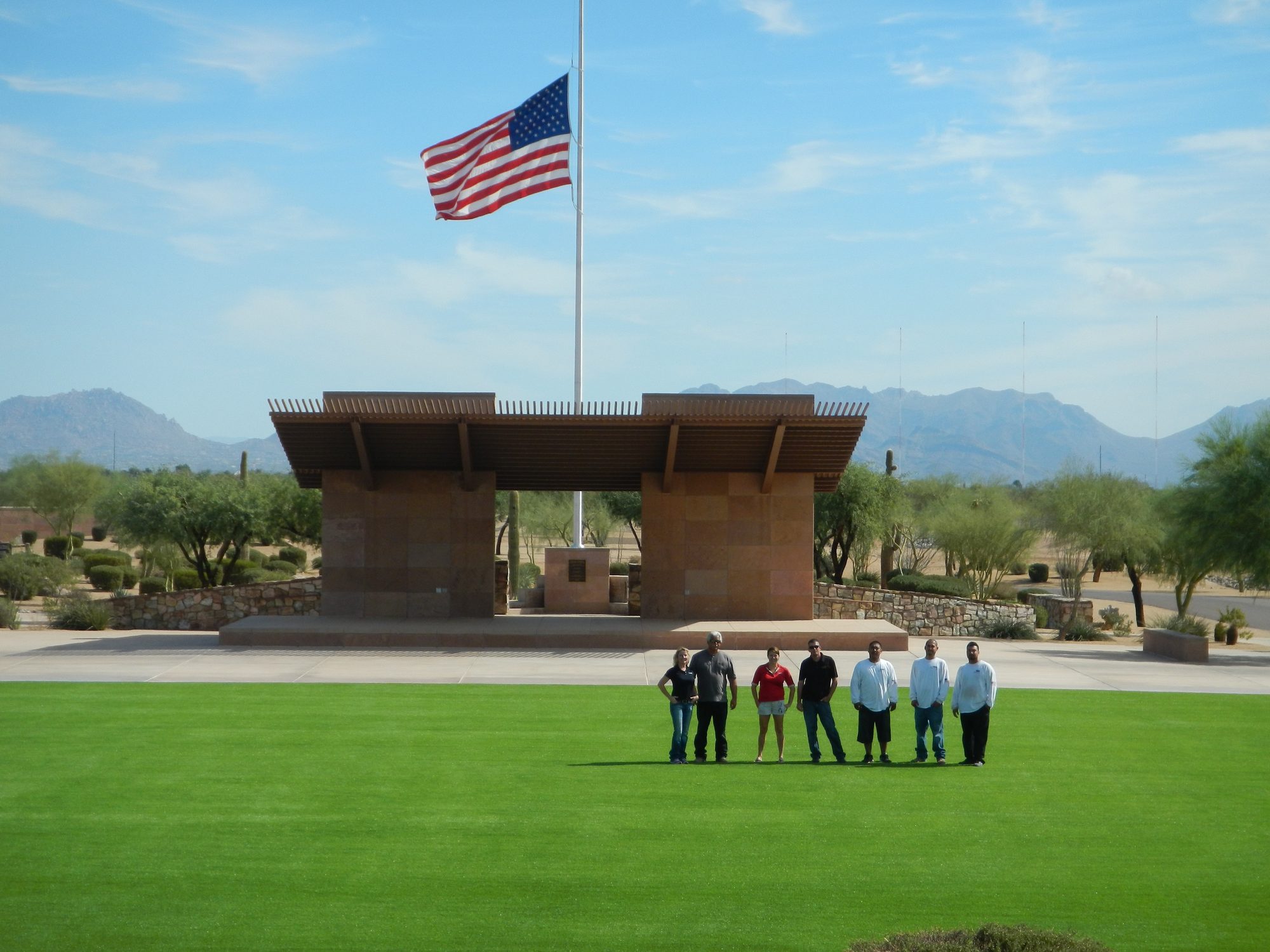
In 2012, Arizona Turf Masters converted approximately 21,000 square feet of irrigated natural turf at the National Memorial Cemetery of Arizona in Phoenix to artificial turf, at an approximate capital cost of $140,000. The goal was straightforward: cut long-term water use and recurring maintenance in one of the most water-scarce regions in the country, without compromising the dignified, consistent appearance a national memorial deserves.
Thirteen years later, the long-term picture is the kind of data that public-sector and commercial facility managers rarely get to see. Using conservative, widely accepted regional benchmarks, here is what that single decision has returned.
The water conservation math
Guidance from the Arizona Department of Water Resources, EPA WaterSense, and the City of Phoenix Water Services Department indicates that irrigated turfgrass in Central Arizona requires roughly 55 to 75 gallons per square foot per year. To stay conservative, this analysis uses 60 gallons per square foot per year.
At that rate, the converted area eliminated about 1.26 million gallons of irrigation demand every year. Over 13 years, that is approximately 16.4 million gallons of potable water no longer pulled from a stressed desert supply. Applying a conservative long-term blended commercial rate of $4.00 per 1,000 gallons, the water cost avoidance alone comes to roughly $65,600.
The maintenance savings
Institutional turf is expensive to keep alive. Mowing, fertilization, weed and pest control, overseeding, irrigation repair, labor, fuel, and equipment all add up year after year. Federal and industry benchmarks from RSMeans, the GSA, and the National Recreation and Park Association place institutional turf maintenance between $1.25 and $2.00 per square foot annually.
Using a conservative $1.50 per square foot, the converted area avoids about $31,500 in maintenance every year, or roughly $409,500 across the 13-year window. That is the line item that quietly dominates the lifecycle math.
The full financial picture
| Category | Estimated savings (2012 to 2025) |
|---|---|
| Water cost avoidance | ~$65,600 |
| Maintenance cost avoidance | ~$409,500 |
| Total savings to date | ~$475,000 |
Set against the approximate $140,000 capital cost, the project reaches estimated payback in about 4 to 5 years. Net savings across the 13 years land near $335,000, with ongoing annual savings in the range of $35,000 to $40,000 that continue for the remaining life of the system.
The dollars are only part of it. The conversion also reduced potable water demand in a drought-prone region, eliminated fuel-powered mowing emissions, cut labor exposure and equipment wear, and made the grounds budget far more predictable. And it did all of that while holding the clean, dignified appearance appropriate for a national memorial.
A replicable model for Arizona facilities
The specific site is a memorial cemetery, but the math is not unique to it. Cities, school districts, parks departments, university campuses, HOAs, and commercial properties across the Valley all face the same equation: irrigated turf is a recurring cost that never stops, while a quality conversion front-loads the spend and then pays it back for two decades.
In an arid climate, turf conversion can pay for itself faster than most infrastructure upgrades a facility will consider. Arizona Turf Masters handles the full scope, from base preparation and drainage to product selection and installation, for residential, commercial, HOA, and public projects. You can see examples of completed work across the Valley in our project gallery, or review what goes into a quality install in our services overview.
Frequently asked questions
How much water can a commercial turf conversion save in Arizona?
It depends on the area and the irrigation it replaces, but using a conservative 60 gallons per square foot per year, every 1,000 square feet of converted turf eliminates roughly 60,000 gallons of irrigation annually. At scale, that adds up quickly, as the 16.4 million gallon estimate above shows.
How long until a commercial turf conversion pays for itself?
In this analysis, estimated payback landed in about 4 to 5 years, driven mostly by avoided maintenance. The exact timeline depends on your water rates, the maintenance you are currently carrying, and the size of the project.
Is artificial turf appropriate for cemeteries and memorial sites?
For the right areas, yes. A quality install holds a consistent, dignified green appearance year round with no browning, mowing, or overseeding, which is part of why it suits high-visibility public grounds in a desert climate.
How were these savings calculated?
They are conservative estimates modeled on publicly available guidance from federal, state, and municipal agencies, plus widely used maintenance benchmarks. The methodology and sources are listed below, and actual results vary by site.
Does Arizona Turf Masters handle municipal and federal projects?
Yes. We work on residential, commercial, HOA, municipal, and public-sector installations across the Phoenix Valley. For a site-specific water and lifecycle estimate, request a facility analysis or see our pricing guide.
Honoring those who served
This is hallowed ground. The National Memorial Cemetery of Arizona is the final resting place for thousands of veterans and their family members, and maintaining a space worthy of their service is a responsibility our team carries with pride. We are honored to have played a part in keeping these grounds green, dignified, and ready for the families who come to visit. To every veteran, and to every family who has given so much, thank you.
The bottom line
One landscape decision in 2012 has conserved an estimated 16.4 million gallons of water and roughly $475,000, and it is still saving tens of thousands of dollars a year. Evaluated over a full operating horizon instead of a single budget cycle, turf conversion is one of the clearest lifecycle wins available to a facility in a water-scarce region. The question for most Arizona facilities is not whether the math works. It is how soon they start the clock.
Arizona Turf Masters can model a site-specific water and lifecycle estimate for your property, residential, commercial, HOA, or public-sector, using the same conservative benchmarks shown here. No pressure, just numbers you can take to a budget meeting.
Request a Facility Analysis →Methodology and sources
- Water use benchmarks: U.S. EPA WaterSense (Outdoor Water Use), Arizona Department of Water Resources (Landscape Watering Guidelines), and City of Phoenix Water Services Department (Landscape Conservation Guidance).
- Maintenance cost benchmarks: RSMeans Facilities Maintenance & Repair Cost Data, U.S. General Services Administration (Grounds Maintenance Standards), and the National Recreation and Park Association.
- Turf lifecycle: Synthetic Turf Council municipal and federal lifecycle cost references.
About this analysis: All savings figures are estimates modeled on conservative assumptions drawn from publicly available federal, state, and municipal guidance and widely accepted industry benchmarks. Actual savings vary based on site-specific irrigation practices, water rates, and maintenance protocols. This analysis is provided by Arizona Turf Masters for informational and planning purposes and does not represent an official endorsement by the U.S. Department of Veterans Affairs or any federal agency.