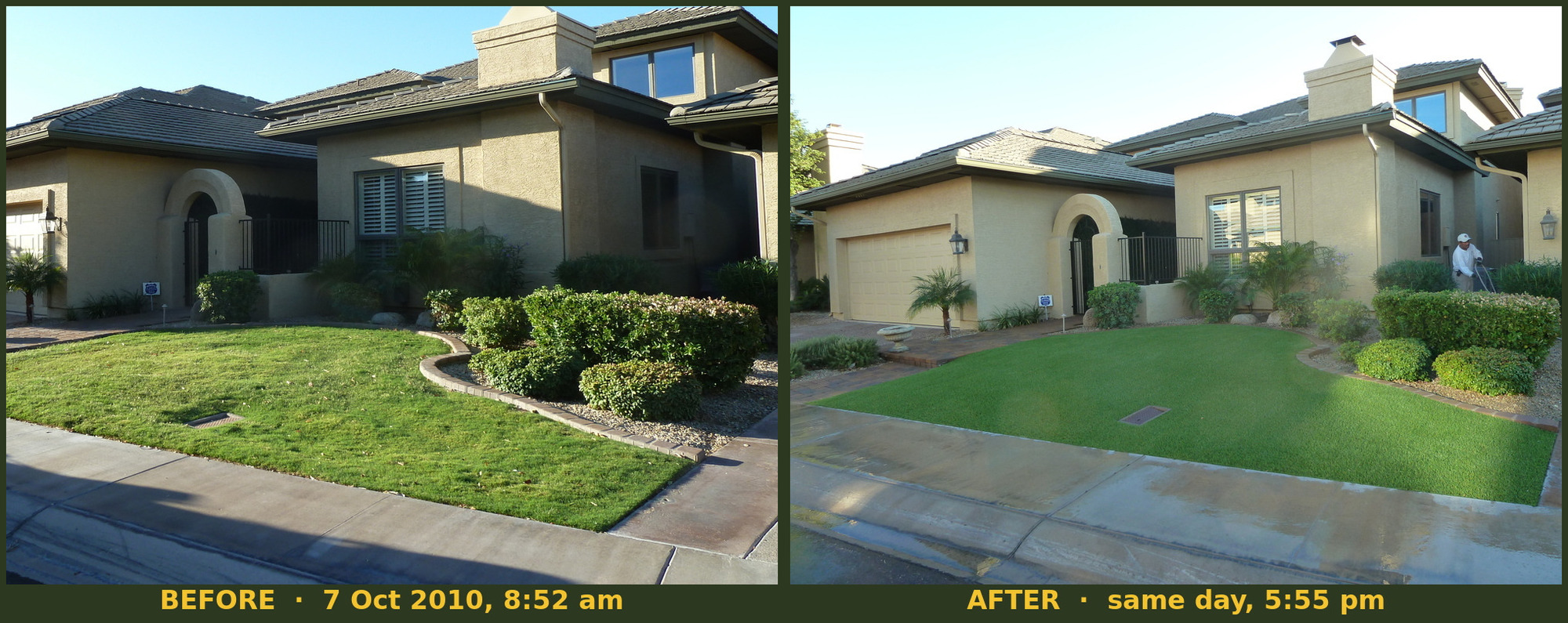
A reserve study is the list of things an association owns that will wear out, what each will cost to replace, and how much to set aside every year so the money is there. Synthetic turf belongs on that list. It rarely makes it.
Most reserve studies cover the obvious: roofs, asphalt, pool equipment, perimeter walls, paint. Each one gets a useful life, a replacement cost, and an annual contribution, so that when the day arrives the association writes a check from a fund instead of a letter to the owners.
Synthetic turf fits that description exactly. It is expensive, the association pays for it, and it wears out. But the person preparing the study builds the component list by walking the property and asking the board what they own, and turf that was installed well does not announce itself. Nobody thinks to mention the front yards.
So it never gets a useful life. It never gets a replacement cost. It contributes nothing to the funding plan. And on the day it finally needs replacing there is no money set aside for it, so the cost arrives as a special assessment. That is the whole problem, and it is entirely avoidable with one conversation.
Is synthetic turf a reserve component? When the association is financially responsible for it, it can meet all four criteria. The test is below.
Why does it get missed? Component inventories are built partly from conversation with the association. Nobody mentions the turf, so it never enters the study.
What happens then? No useful life, no replacement cost, no dollars in the funding plan, and a special assessment when it wears out.
What did this project cost? $102,000 in 2010 for roughly 14,500 square feet across about 30 front yards. Across the documented service life that is about $212.50 per home, per year.
Is replacement the same price as the original install? Usually not. A properly built base is often reusable, so repeating the old bid over collects from owners.
Why this is worth ten minutes right now
Arizona does not require associations to perform reserve studies and sets no minimum funding level. What it increasingly requires is disclosure. HB 2397 amends A.R.S. 33-1260 and A.R.S. 33-1806 and takes effect with the 2026 general effective date, widely reported as September 12, 2026.
It expands what has to go to a buyer on resale. Alongside the declaration, bylaws and rules, the packet must now include a copy of the most recent reserve study, with a summary permitted where the study runs more than ten pages, plus the association's most recent income and expense statement for all operating and reserve accounts, the operating budget, the most recent audit, review or compilation, the three most recent sets of board minutes, and a summary of pending litigation. Preparation and delivery of that packet is capped at $400, with up to $50 for an update if thirty days have passed.
The part boards should read twice is the remedy. HB 2397 also changes the liability standard for resale disclosures. A purchaser or seller who suffers damages may pursue legal or equitable remedies where required information is not disclosed, or where an owner or association knowingly or recklessly provides materially false or misleading information in the disclosure report. The law also permits recovery of reasonable attorney fees when awarded by the court.
Importantly for HOA boards and community managers, HB 2397 does not appear to impose liability simply because an innocent omission or mistake occurs. The statute expressly allows disclosure information to be based on good-faith reliance on the association's records or information, without requiring an independent investigation or validation. Associations should nevertheless have a consistent process for maintaining records and preparing resale disclosures so required information is not knowingly or recklessly omitted or misstated.
The practical effect is that the reserve study stops being an internal planning document and starts leaving the building on every home sale. A study with a hole in it becomes a disclosure with a hole in it. Boards and managers should confirm the current statutory text and their own obligations with association counsel. What follows is about how a turf component behaves, not legal advice.
How a reserve study actually gets built
Under the National Reserve Study Standards every study has two required halves, and five tasks between them.
| Half | Task | What the analyst is doing |
|---|---|---|
| Physical analysis | Component inventory | Selecting and quantifying which assets qualify, using a site visit, document review, and discussion with the association |
| Condition assessment | Judging current condition from observation | |
| Life and valuation estimates | Assigning useful life, remaining useful life, and current replacement cost | |
| Financial analysis | Fund status | Reporting the reserve balance as cash and as percent funded |
| Funding plan | Building the income plan, over a minimum of twenty years |
Studies come in three levels. A Level I full study builds and quantifies the inventory from scratch, on site. A Level II update verifies an existing inventory rather than rebuilding it, still on site. A Level III update skips the site visit entirely and refreshes only the life and valuation estimates, the fund status, and the funding plan.
That progression matters more than it looks. An omission made in the first Level I study gets carried forward by every Level II and Level III update after it, because those updates verify and refresh what is already on the list. They are not looking for what is missing.
The four part test, and where grass and turf land
An asset qualifies as a reserve component only if all four are true.
| Test | Natural grass | The turf at this community |
|---|---|---|
| Current financial responsibility of the association | Yes | Yes. The association budgeted it, paid for it, and maintains the front yards. |
| Limited useful life | No. Continuous, not periodic. | Yes. It wears and is eventually replaced. |
| Predictable remaining useful life | No. | Yes. Observed at sixteen years and still serving. |
| Above what the operating budget absorbs | No. Absorbed annually, forever. | Yes. It is a capital event. |
Grass fails on three of four, which is not a knock on grass. It simply means lawn care is an operating expense and always will be. Turf passes all four, which means it can be scheduled, funded on a curve, and seen coming.
Can an association even do this as a reserve project?
This is usually the objection, and the answer is in the standards themselves. Boards often assume a reserve project has to put back what was there. It does not.
"A component replacement is not required to be with a similar component. Logical upgrades to an existing asset or system that is obsolete, inefficient, or no longer effectively serves the needs of the association can be accomplished as a reserve project."
"Selection of components, or selection of useful life and remaining useful life, may consider energy usage and ongoing maintenance costs which have an impact on total budgetary expenses and total life cycle costs."
Read those two passages together and the path is clear. A landscape that is failing in the conditions it sits in is, in the plain sense of the standard, no longer effectively serving the association. Converting it is a logical upgrade rather than a like for like replacement, and the standard expressly permits weighing ongoing maintenance cost and total lifecycle cost when making that call.
That is worth saying plainly, because it is not a contractor's opinion. It is the standard your reserve analyst already works to.
The gap that costs associations real money
Look again at the first task. The component inventory is assembled from a site visit, document review, and discussion with the association. An analyst walking a property sees green ground. Turf that was installed well and has been maintained does not announce itself, and there is no reason a reserve specialist would assume a front yard is synthetic unless somebody says so.
If it never enters the inventory, the consequences run all the way through the study.
- No useful life is assigned to it
- No current replacement cost is estimated
- It contributes nothing to the fully funded balance, so percent funded reads higher than the association's real position
- It receives no dollars in the funding plan
Then one day it needs replacing and there is no money set aside for it. That expense does not disappear. It arrives as a special assessment, which is the outcome most boards are working hardest to avoid.
Life and valuation estimates require a current replacement cost. Reserve analysts are specialists in reserve studies, not in turf. For a component like this they have to ask somebody. If no one supplies a figure, the component either stays out of the study or goes in with a number that was guessed.
Arizona Turf Masters will measure the area, price the replacement scope, and put base depth, product specification and infill type in writing, so your reserve analyst has a real figure to work with instead of a guess. Board and architectural submittal packages are provided at no charge as well. Call (480) 751-4343.
Request a Written Replacement Cost →What happened at the Biltmore property
The community sits in the Biltmore area of Phoenix, behind a gate, with a mature ficus canopy that is the best thing about walking through it. Deep, dense shade in a city that offers very little of it.
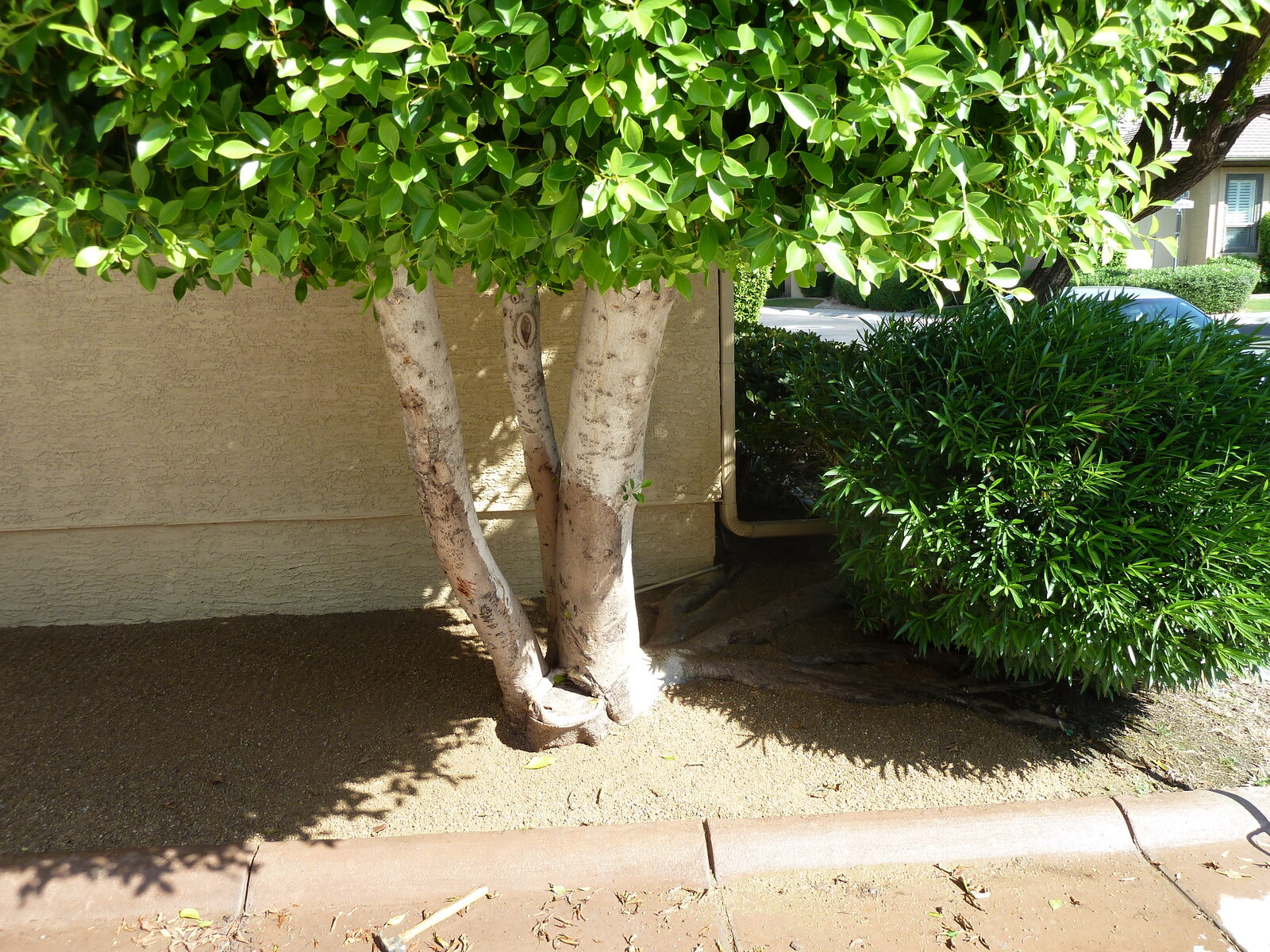
That canopy was also killing the lawns. Photographs taken on site in September 2010 show bare dirt against the stucco, directly under the trees, with the irrigation line running right through it. The ground was being watered. Nothing was growing. Grass cannot photosynthesize in that much shade, and no amount of water, fertilizer or reseeding changes that.
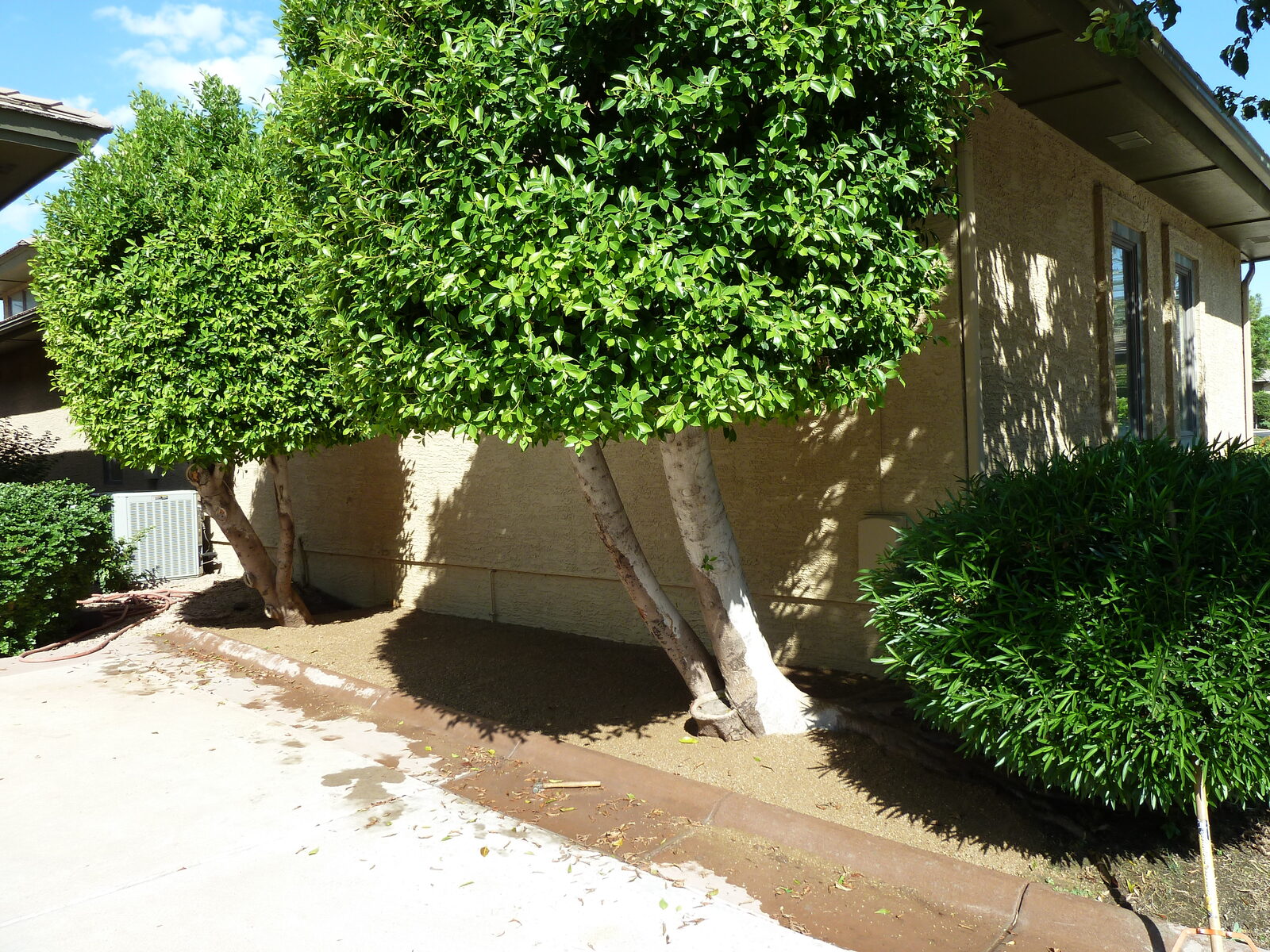
It was not uniform across the community. Under the heaviest canopy the ground had given up entirely. Elsewhere the lawns were still green, but thin, patchy and worn, and they stayed that way only because the association kept paying to hold the line. Most boards recognize the second situation faster than the first. It is the more expensive one, because it never quite gets bad enough to force a decision.
Three costs that came with the failing lawn
The overseed, every winter. Bermuda goes dormant and brown in Arizona winters, so the standard response is to scalp it in the fall, spread perennial ryegrass seed, water heavily until it germinates, then mow all winter and manage the transition back in spring. AMWUA puts the seasonal water cost of an overseeded lawn at about 8,000 gallons per 1,000 square feet, against roughly 500 gallons for a dormant one. The City of Scottsdale publishes the same figure independently, estimating 8,000 gallons per season per 1,000 square feet of winter grass, and notes that real bills often run higher than that baseline. On a lawn this size that is on the order of 136,000 gallons every winter, and about 127,500 of it is the overseed itself. Then add seed, scalping, labor, and a full season of mowing a dormant lawn would not need.
Worth knowing before your next architectural review: Scottsdale's ordinance, updated in 2022, prohibits an HOA from requiring its members to overseed for a winter lawn, and the city asks residents to voluntarily skip it. Cities are moving away from the expectation of green grass twelve months a year, not toward it.
Now put that in the shade. Ryegrass seed needs light to establish. Under a canopy like this one, a good portion of that money and water was spent on seed that was never going to take. The community was buying the same bare dirt every year, at retail.
Nutsedge. Purple nutsedge spreads from underground tubers, and University of Arizona Extension guidance is explicit that excessive soil moisture favors it, recommending better irrigation timing and uniformity specifically to reduce it. Control is not one treatment. The Extension program runs burndown applications every 7 to 14 days through spring and early summer, followed by sequential applications in July and mid August, and the stated goal of all that is a manageable population, not eradication.
Look at the sequence. Grass struggles in deep shade, so it gets watered harder. Chronically wet soil is exactly what nutsedge wants. The association then pays for a repeating herbicide program to fight a weed the irrigation schedule was feeding. Every step is a reasonable response to the step before it, and the whole chain runs on a lawn that could not have succeeded anyway.
Irrigation repairs and leaks. An aging system under mature trees develops breaks, and a leak in a front yard is often invisible until the bill or a wet spot says so. The repairs are a recurring unbudgeted expense, and the leak creates the permanently damp ground nutsedge colonizes. Worth noting for reserve purposes too, because the irrigation system is a component in its own right with its own useful life, entirely separate from whatever grows above it.
What the association did, and what it cost
The old grass was cut out with a sod cutter and hauled off. New base aggregate was trucked in, staged and compacted. Irrigation was addressed at the valve. Then turf went down across the front yards. The ficus, the palms, the shrubs and the paver walks all stayed. Most of the work was done in 2010. Three homeowners opted out at the time, and later paid to convert their own yards themselves, so the community finished with more turf than that first invoice covered.
Arizona Turf Masters billed the association $102,000 to convert roughly 14,500 square feet across about 30 front yards.
Community wide that is about $6,375 a year, or roughly 38 cents per square foot per year. It is not a projection and it is not a savings claim. It is the capital cost divided by the homes it covered, divided by the years it has delivered.
What sixteen years tells a reserve analyst
This is the part that belongs in a study rather than a brochure. A useful life assumption is a judgment call, and observed service life is better evidence for it than a manufacturer warranty term, because a warranty is a liability cap rather than a service expectation.
| If useful life were assumed at | Remaining useful life today | Effective age over useful life |
|---|---|---|
| 15 years | Would have reached zero last year | 100 percent depreciated |
| 20 years | About 4 years | 80 percent |
Two rows, not three, and that is deliberate. We would not plan an Arizona community around a 25 year turf life. Fifteen is a sound planning assumption in this climate. Twenty is already optimistic. Arizona sun is harder on synthetic fiber than almost anywhere in the country, and a table like this is exactly where a contractor starts quietly arguing for the longest number. The longest number is not the honest one.
Plan on fifteen. If you get sixteen, or more, that is upside the association never had to fund.
The component is still in service at sixteen. That is one observed data point from one Arizona installation, and it is offered as exactly that. It is not a recommendation to assign any particular useful life in your study. That is your analyst's call, on your components, in your conditions, and a front yard under dense shade is a gentler environment than a pet area or a play surface.
Replacement cost is not the same as install cost
When the time comes, the number is usually smaller than the original invoice. Most of the cost of a first install goes into demolition and base construction, cutting out sod, hauling it, trucking in aggregate, grading and compacting. A properly built and compacted base is often reusable. Replacement can be closer to removing the old surface, refreshing infill and laying new turf.
This matters in a reserve study specifically. An analyst who simply repeats the original bid overstates the reserve requirement and over collects from owners. Have the replacement scope priced separately when you set the component, and ask whoever prices it to say in writing what they assume about the base.
How boards find the money
Funding plans in the standards are ranked by risk. Full funding holds reserves at or near 100 percent and is the most conservative. Threshold funding keeps the balance above a set dollar or percentage floor. Baseline funding only prevents reserve cash from reaching zero and carries the highest risk. Statutory funding is whatever the jurisdiction requires. For a project like this one, three practical paths exist.
- Operating budget. Fund it from the annual assessment stream, generally phased across budget years. No special vote, slowest path, competes with every other line.
- Reserves. If the component is in the schedule and the schedule is funded, the money is there by design. This is the whole argument for getting turf into the study before you need it rather than after.
- Special assessment. Fastest to fund and least popular. Depending on the documents and the amount, it usually requires a membership vote.
There is a fourth thing worth planning for, and it is not a funding strategy so much as a question you want answered before you start: what happens when an owner opts out. At this community three homeowners declined at the time and later paid to convert their own yards themselves. Decide in advance how an opt-out is handled, what the standard is for an owner who converts later, and who owns and maintains that yard afterward. It is much easier to settle on paper than after half the street is done.
Running the numbers on your own community
We are not going to hand you a savings figure for someone else's association, because we do not know what your landscape contract costs. Here is the arithmetic instead. At this community's rate of about $6,375 a year in capital cost across the documented service life, the comparison looks like this.
| If your association spends | Net per year | Simple payback |
|---|---|---|
| $8,000 a year on that landscape | $1,625 | 12.8 years |
| $12,000 a year | $5,625 | 8.5 years |
| $15,000 a year | $8,625 | 6.8 years |
| $20,000 a year | $13,625 | 5.1 years |
| $25,000 a year | $18,625 | 4.1 years |
Across the conversions we have done, five years is the payback we see most often. On this table that lands around a $20,000 a year landscape spend, which is a realistic figure for a community maintaining this much lawn in Phoenix. That is what we see in the field, not a guarantee, and your own contract is the only number that settles it.
This table is illustrative. Put your own numbers in it. Include water, mowing, fertilizer, weed control, irrigation repairs, and any reseeding or resodding cycle, because on a shaded lawn that last one is often the largest and the most invisible. For context, widely used institutional benchmarks from RSMeans, the GSA and the National Recreation and Park Association place grounds maintenance between $1.25 and $2.00 per square foot per year, though a residential front yard program is generally lighter than institutional grounds.
The water, and why you will see two different numbers
Turf conversion water savings get quoted at wildly different rates, and it is worth understanding why before you put one in a budget.
| Figure | What it measures | Source |
|---|---|---|
| About 34 gallons per square foot per year | Roughly what the grass needs, at 55 inches of applied water for Bermuda with winter overseed, under efficient irrigation | AMWUA landscape watering guidance |
| 55 to 75 gallons per square foot per year | What irrigation systems actually deliver, including inefficiency, overspray, evaporation, runoff and overwatering | ADWR, EPA WaterSense, City of Phoenix |
Both are defensible because they are answering different questions. Real systems apply more than the agronomic requirement, and the gap widens on a lawn somebody is trying to rescue. That is precisely what was happening here, so this property likely sat toward the upper part of the delivered range rather than the lower.
Across roughly 14,500 square feet, the honest range is about 8.0 to 13.9 million gallons over sixteen years. Priced at the City of Phoenix low season volume charge in the schedule effective March 1, 2025, the most conservative rate the city publishes, that is roughly $3,200 to $5,700 a year, or about $108 to $190 per home, per year. Summer rates and environmental charges are both higher.
Set that against the $212.50 per home, per year that the turf cost. Water alone covers somewhere between half and nine tenths of it, before a single mowing. We would rather show you the range and name the basis than pick the flattering end and present it as precision. Our 13 year municipal case study uses the delivered water basis and walks the full lifecycle math for a larger public site.
What maintenance looks like now, honestly
Turf does not end landscape maintenance at a community like this one. It ends a specific cycle.
| Task | Shaded turf grass | Synthetic turf |
|---|---|---|
| Mowing and edging | Weekly in season, and all winter when overseeded | None |
| Fall scalping and overseed | Every year, seed plus labor plus heavy germination watering | None |
| Spring transition | Managed every year, often by stressing the lawn | None |
| Fertilizer and weed control | Ongoing, plus a dedicated nutsedge program | Spot weeding at edges and seams |
| Irrigation on the lawn area | Year round, plus repairs and leaks | None on the turf itself |
| Irrigation for trees and shrubs | Required | Still required |
| Leaf and debris removal | Required | Required, and heavier under a canopy |
| Rinsing and brushing | Not applicable | Periodic, more where there is traffic or pets |
| Resodding failed areas | Recurring in deep shade | None |
Two rows there deserve more attention than they get. The irrigation system does not disappear. The ficus, the palms and the shrubs still need water, so the system gets reduced and re zoned rather than removed. Budget for it, and keep it in the reserve schedule where it belongs.
And leaf litter goes up, not down. A dense canopy drops constantly, and it sits on top of turf instead of disappearing into a lawn. Any contractor who tells a board that turf means nobody comes back is not describing this property.
On nutsedge, be careful about what anyone promises. It regrows from tubers left in the soil, so what matters is how much of that soil comes out during excavation and how the base is built on top of it. Ask any bidder to put excavation depth in writing, and treat a flat guarantee that the weed is gone forever the way you would treat any other absolute claim.
What to check before you commit
- Turf gets hot in Arizona summer sun. Cooling infill, lighter reflecting fiber, shade and a hose all help. Under a canopy like this one it is far less of an issue.
- Cheap installs fail at the base, not the blade. Seams separating, ripples from poor compaction and low spots that hold water are base problems. Get base depth in writing.
- Energy efficient low emissivity window glass on a west facing elevation can concentrate reflected sun and melt fibers. It is checked on every estimate. Very few people mention it.
- Mature tree roots move. Ficus in particular have aggressive surface roots, and a base built without accounting for them will telegraph over time.
- Confirm in your governing documents who is actually responsible for the area. That answer determines whether it belongs in your reserve study at all.
Bring it to your board
If this is a conversation your community needs to have, we will come have it with you. Arizona Turf Masters presents to HOA boards at no charge, in person or virtually, anywhere in the Valley or Tucson.
The format scales to the meeting. A full visual presentation for a larger board meeting, or a smaller working session with handouts, turf samples, specifications, warranty information, maintenance considerations and product standards. Mary Clanton, our Director of Operations, usually leads it.
What boards ask about most: how to tell product quality apart, installation and drainage standards, warranties, water conservation, what maintenance actually looks like afterward, and reserve study planning.
And the one most boards have not thought about yet: what your CC&Rs and architectural guidelines actually say about artificial turf. Most were written before turf was common, or written loosely enough that anything passes. That is how a community ends up approving a cheap install that becomes everyone's problem for a decade. We will walk you through what to specify and why, whether or not you ever buy anything from us.
Free, in person or virtual, Valley wide and Tucson. Ask for Mary or Kera. Call (480) 751-4343. Serving the Valley and Tucson since 2006. Rated 4.6 stars across 301 Google reviews. AZ ROC #234276.
Request a Presentation →Frequently asked questions
Our front yards are on private lots. Does that disqualify the turf from our reserve study? Not by itself. The first test is the association's financial responsibility, not who holds title. In many Arizona communities the governing documents assign front yard landscape maintenance to the association. Confirm what yours say.
Our study is a Level III update. Will the analyst catch a missing component? Generally no. A Level III update has no site visit and refreshes life and valuation estimates, fund status and the funding plan for components already on the list. Missing components tend to stay missing until a Level I or Level II study revisits the inventory.
How do we get a replacement cost for the component? Ask a turf contractor for a written figure for reserve study purposes and give it to your analyst. Arizona Turf Masters provides this at no charge.
Will this get rid of our nutsedge? Be skeptical of anyone who answers that with a flat yes. It regrows from tubers, so the honest answer depends on excavation depth and base construction. What does change is the condition feeding it, because you are no longer irrigating that ground daily.
Do we still need our irrigation system? Yes. The trees and shrubs still need water. The system typically gets reduced and re zoned rather than removed, and it stays a reserve component with its own useful life.
Does turf mean no more landscape contractor? No. Mowing, edging, overseeding and lawn irrigation go away. Leaf and debris removal stays, and under a mature canopy it can increase.
Can we do it in phases? Yes, and many communities do. It spreads the cash requirement and it is how this project was handled.
Will you come talk to our board? Yes, at no charge, in person or virtually, anywhere in the Valley or Tucson. We can do a full presentation for a board meeting or a smaller working session with samples and specifications. Ask for Mary or Kera.
How much does turf cost installed? Turf installs run $6.00 to $12.00 per square foot installed. Minimums do apply. Scope, access, base depth and product all move the number. Our Arizona cost guide breaks the ranges down further.
Named sources
- Community Associations Institute, National Reserve Study Standards. Definitions, the four part component test, the three study levels, and the funding plan goals.
- Arizona HB 2397, amending A.R.S. 33-1260 and A.R.S. 33-1806. Bill text and Senate fact sheet, Arizona State Legislature, Fifty-seventh Legislature, Second Regular Session. The statute carries the 2026 general effective date; the September 12, 2026 calendar date is as reported by Arizona community association counsel and should be confirmed with your own.
- Arizona Municipal Water Users Association, landscape watering guidance, and seasonal overseeding water figures of about 8,000 gallons per 1,000 square feet versus about 500 gallons for a dormant lawn.
- Arizona Department of Water Resources, U.S. EPA WaterSense, and City of Phoenix Water Services, delivered irrigation benchmarks for Central Arizona turfgrass.
- City of Tempe Water Conservation, ten reasons to skip winter overseeding.
- City of Scottsdale Water Conservation, winter overseeding guidance and Ordinance No. 4567, and the estimate of 8,000 gallons per season per 1,000 square feet of winter grass.
- Arizona Department of Water Resources, landscape water use, including the estimate that as much as 70 percent of residential water use is outdoors.
- University of Arizona Cooperative Extension, publication az1818, Strategy for Nutsedge Control in Turf, Kai Umeda, 2020.
- City of Phoenix Water Services, water rate schedule effective March 1, 2025.
- RSMeans, U.S. General Services Administration, and the National Recreation and Park Association, grounds maintenance cost benchmarks.
- Arizona Turf Masters project records and dated site photography, 2010.
This article is an educational aid for boards and community managers. It is not a reserve study, not a project specific design, and not legal or financial advice. Reserve studies in Arizona are normally prepared by a credentialed reserve analyst. Statutory citations and effective dates should be verified with association counsel before you rely on them, and published utility rates change. Project figures are from one Arizona installation and are described as measured, estimated or modeled where each applies. Arizona Turf Masters, leaders in Arizona turf since 2006.