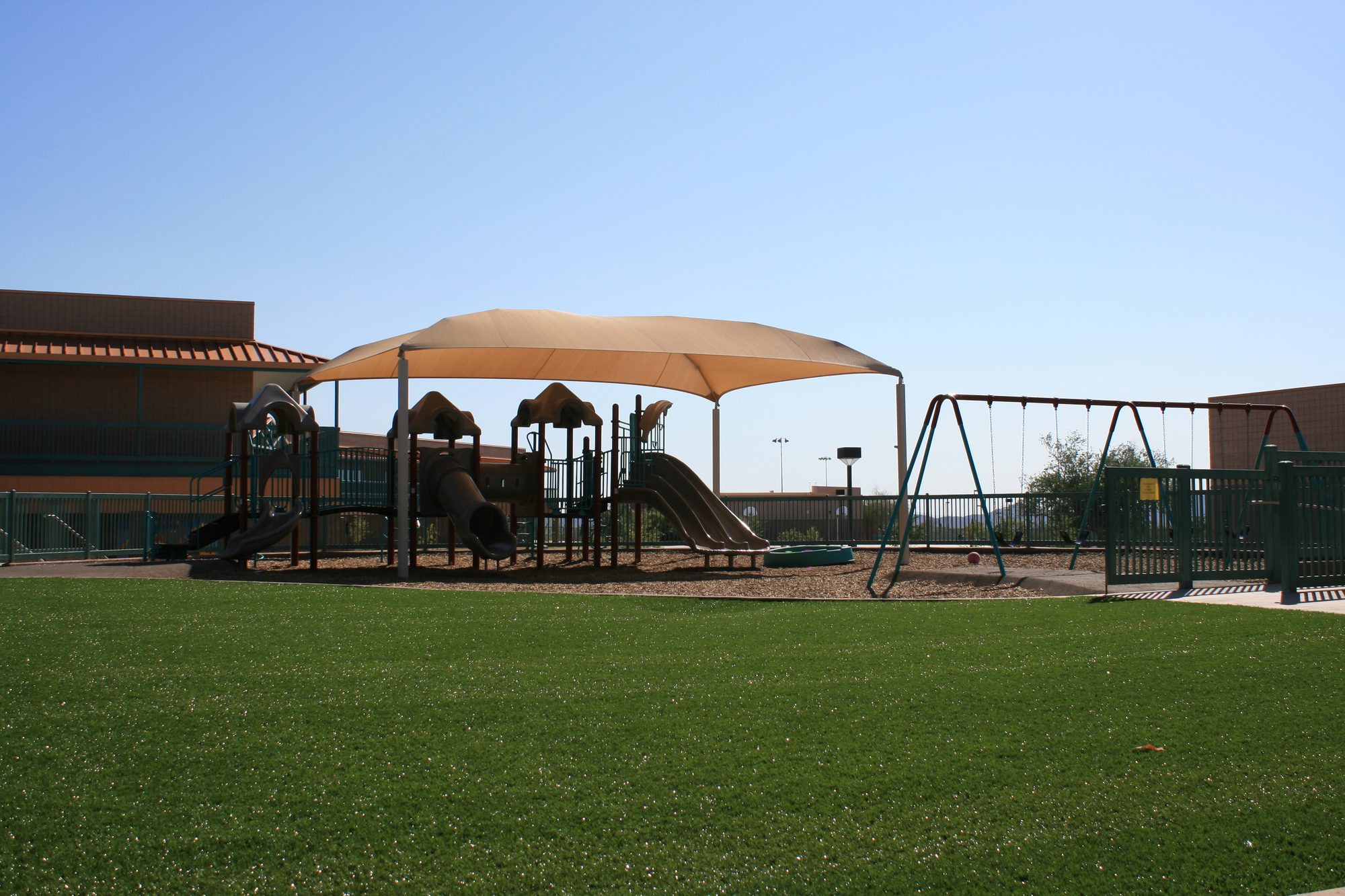
A play area can be so much more than a swing set placed in the dirt. It can become a complete outdoor environment with places to climb, jump, imagine, race, splash, practice, relax and grow.
Can turf go under my shade trees? Usually yes. Turf needs no sunlight, so it thrives where Bermuda thins out under a canopy. The design just has to leave room around the trunk and keep irrigation reaching the tree.
Will it get rid of stickers and thorny weeds? It greatly reduces them by covering the bare dirt where they take hold. No surface is completely weed-proof, but the difference for bare feet is night and day.
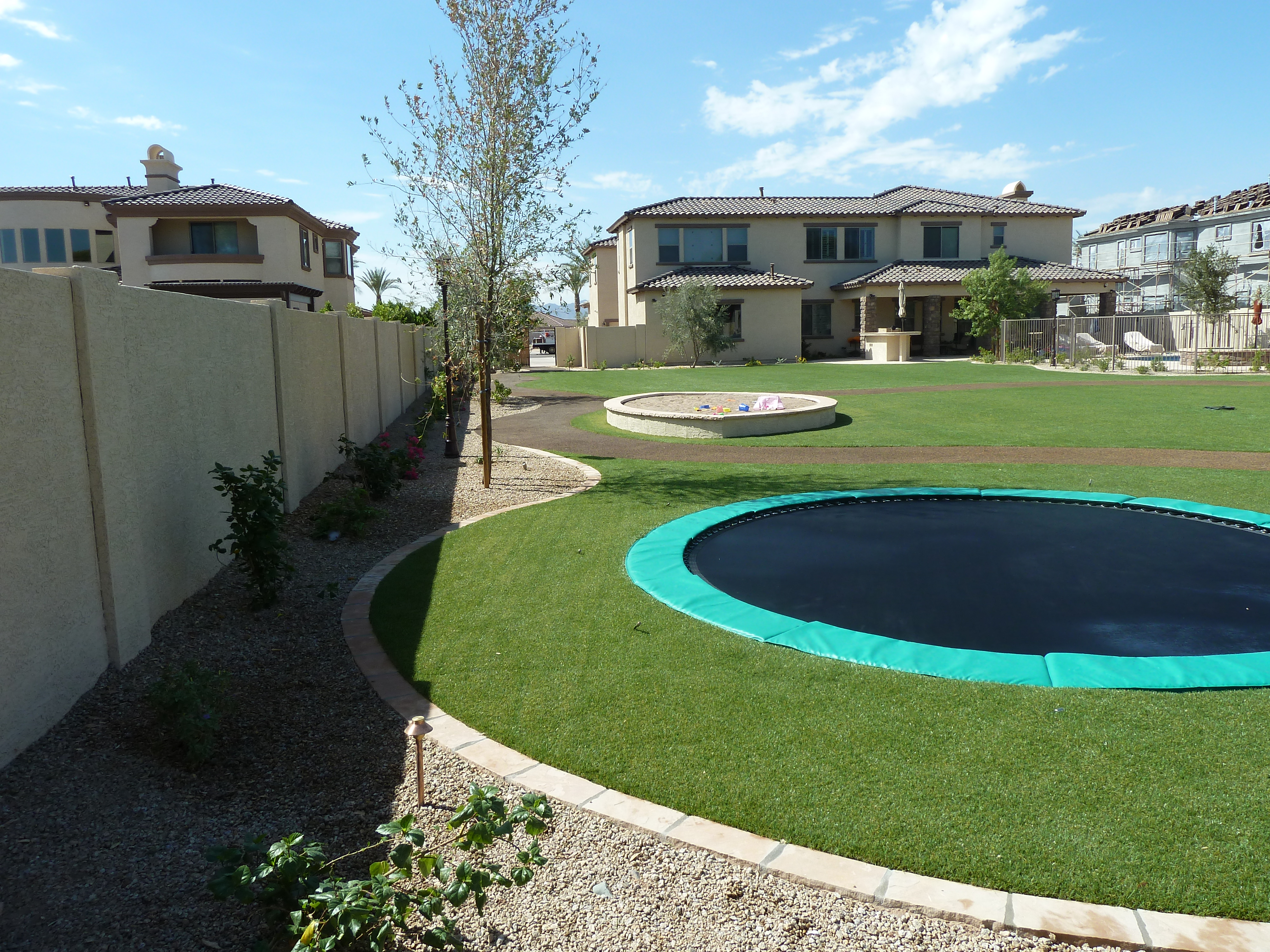
Can we build in a trampoline, games, and water play? Yes. In-ground trampolines, hopscotch and racetrack inlays, and splash zones all work when the drainage and base are planned for them from the start.
A play space should invite kids outside
Kids are hard on a yard, and that is exactly what a good play space should be built to handle. They run the same path to the slide, land beneath the same swing, race around the trampoline, drag toys through their favorite corner and gather beneath the best shade tree.
In an Arizona yard, those everyday play patterns can quickly expose the limits of natural grass. Bermuda thins under heavy traffic, struggles beneath substantial shade and often gives way to compacted dirt, dusty bare spots, stickers and thorny weeds. The equipment may still be there, but the ground around it stops feeling inviting.
I am Mary Clanton, Director of Operations at Arizona Turf Masters, a mother and a grandmother. I have spent 17 of our company's 20 years helping Arizona families and organizations rethink difficult outdoor spaces. The best projects do not begin with a turf sample. They begin with a simple question: what would make the children who use this space excited to go outside?
Keep the trees. Lose the struggling grass. Build the play space.
Kids need shade. Bermuda needs sun.
That simple conflict explains many of the bare, difficult areas we see in Arizona backyards and playgrounds.
A mature shade tree is one of the best features an Arizona property can have. It cools the setting, creates a natural gathering place and extends the hours children can comfortably spend outside. But Bermuda grass needs strong sunlight. As a tree canopy fills in, the grass underneath commonly becomes thin and weak. Add concentrated foot traffic from children, pets and playground equipment, and the lawn can disappear altogether.
Homeowners often feel forced to choose between two things they want: great trees that provide usable shade, or a green lawn that requires substantial water, mowing, fertilizing, weed control and ongoing repair. Artificial turf offers a practical third option. It can replace the struggling grass while allowing the trees and the shade they provide to remain part of the design.
Installing around mature trees still requires thoughtful planning. Tree wells should allow room for trunk growth, root zones must be respected and irrigation must continue reaching the trees. Artificial turf does not need sunlight or watering, but the living landscape around it still does.
Start with the way children actually play
Custom does not mean choosing the most expensive equipment. It means creating a layout that fits the children, the property and the way the space will be used every day. Before planning the surface or equipment, consider:
- Ages and abilities. A toddler, a grade-school child and a group of teenagers need very different kinds of movement, challenge and supervision.
- Favorite activities. Some children want to climb and jump. Others gravitate toward sports, imaginative play, water, art, sensory experiences or open space.
- Traffic level. A family backyard has different demands than a preschool, school courtyard, church, HOA or community playground used by many children each day.
- Shade and sightlines. Adults need comfortable places to sit, and caregivers need to see the active areas without standing in the middle of them.
- Pets and shared use. Many backyards serve children and dogs, so drainage, cleanup, infill and separation between activity zones matter.
- Room to grow. A space should be able to evolve as children outgrow toddler equipment and become interested in climbing, games, sports or social areas.
What can a custom outdoor play space include?
This is the fun part. Artificial turf can connect separate activities into one cohesive environment instead of leaving equipment scattered across dirt, rock or struggling patches of lawn.
- A custom play structure. Swings, slides, climbing walls, towers, bridges and imaginative elements, selected for the ages, abilities and interests of the children using the space.
- An in-ground trampoline. A flush or lower-profile trampoline blends into the surrounding turf when the pit, retaining system, drainage, airflow and maintenance access are designed correctly.
- Built-in games. Hopscotch, four square, a miniature racetrack, numbers, letters, pathways or activity markings created with contrasting turf or durable inlays.
- Sensory and imaginative zones. Curved paths, stepping elements, musical play, a playhouse, outdoor art, digging stations or quiet corners for different kinds of learning and play.
- Water play. A splash feature, water table or sensory station, incorporated into an area with properly planned drainage instead of a permanent patch of bare soil.
- Sports and skill areas. A small soccer goal, batting or throwing zone, putting green, chipping area or open practice space that gives older children and adults a reason to use the yard too.
- Open turf. Not every square foot needs equipment. Children need room to run, tumble, create their own games and change their minds.
- Shade and seating. Existing trees, shade sails, pergolas, benches and low seat walls make the play space more comfortable for children and caregivers.
Why artificial turf works where grass gives up
Natural grass can recover from light use, but playground traffic is repetitive and concentrated. The same landing zones and running paths are used every day. Beneath swings, at the bottom of slides, around trampolines and under shade trees, Bermuda often cannot keep up.
A properly designed artificial turf system provides a more consistent foundation in those high-use areas. It does not need sunlight, mowing or time to recover between play sessions. It also helps reduce the bare dirt, stickers and thorny weeds that make many Arizona play areas uncomfortable for bare feet and little hands. Families and property managers appreciate the practical differences:
- Wear protection where it counts. The hardest-worn spots are under the swings and at the bottom of the slide. We install swing mats and a slide landing mat in those zones to take the abuse, protect the turf, and keep the whole play area wearing evenly.
- Less exposed dirt. Compacted soil and dusty bare patches are covered by a finished, usable surface.
- Greatly reduced weeds. A properly built base and maintained surface significantly reduce weed growth, including sticker-producing and thorny weeds. Occasional growth from airborne seeds can still occur, especially along edges.
- No mowing around equipment. No need to trim between posts, beneath slides or around the trampoline frame.
- Purpose-built cushioning options. Padding can be added where the intended use calls for it. Areas beneath elevated equipment should use a surfacing system appropriate for the equipment and required fall height, particularly on commercial projects.
- Drainage and cleanup. Permeable turf and a correctly prepared base allow water to move through the system, while dust, spills and pet areas can be rinsed as needed.
Design for Arizona, not around Arizona
Plan the shade with the surface. Any outdoor surface exposed to full Arizona sun can become hot, including artificial turf, pavers, rubber, concrete and playground equipment. Shade should be part of the plan from the beginning, not treated as an afterthought. Preserving mature trees, adding a shade sail or incorporating a pergola can make the entire play space more useful during more hours of the day.
Respect the trees and living landscape. Turf can be shaped around trunks and planting areas, but it should not smother the tree collar or interfere with irrigation. A well-designed transition protects the tree, gives it room to grow and makes the turf feel intentionally integrated into the landscape.
Build the drainage below the surface. The blades are only the visible layer. Grading, base preparation, drainage, borders, seams and transitions determine how the space performs. This becomes especially important around in-ground trampolines, splash features, low areas and commercial play equipment.
Be honest about maintenance. Artificial turf is lower maintenance than a natural lawn, but it is not no maintenance. Arizona dust and pollen still settle on the surface. Leaves should be removed, high-traffic fibers may need occasional brushing and pet areas need prompt cleanup and rinsing. That routine is very different from continually watering, mowing, fertilizing, reseeding and trying to restore grass in a location where it does not want to grow.
From backyards to schoolyards
Custom play spaces are not limited to residential yards. Across Phoenix, Scottsdale, Mesa, Tempe, Chandler, Gilbert and Glendale, Arizona Turf Masters works with homeowners as well as schools, preschools, childcare facilities, churches, HOAs and community organizations that need outdoor areas capable of handling frequent use.
A backyard can be highly personal, built around one family's children, pets and favorite activities. A commercial play area must also consider traffic flow, accessible routes, supervision, cleaning, maintenance access, documented cushioning systems and how the space will perform when many children use it throughout the day. The setting may change, but the goal is the same: create an outdoor space that feels intentional, inviting and ready to be used.
Build it to grow with them
Children change quickly, and a good play-space plan leaves room for that. A toddler's open crawling area may later become a game zone. A small playhouse may give way to a climbing wall. A flat turf section can transition from tag and imaginative play to sports practice, outdoor gatherings or a putting green.
The value of a flexible foundation is that the yard does not have to be completely rebuilt each time the children enter a new stage. The surface can continue connecting the space even as the activities change.
What 20 years of Arizona experience brings to the project
Arizona Turf Masters is celebrating its 20th anniversary in 2026. Since 2006, our team has installed artificial turf and specialty outdoor surfaces throughout the Valley and Tucson for residential, commercial and community properties.
Two decades in Arizona teaches you that the most important decisions are often the ones hidden beneath or around the finished surface: how the area is graded, where water moves, how edges are secured, how seams are planned, how tree wells are formed, whether the infill matches the use and how the play area connects to the rest of the property.
We are not interested in simply covering a problem area with green material. We want to help create a complete outdoor environment that works for the children, adults, pets and maintenance teams who will use it long after installation day.
Frequently asked questions
Can artificial turf be installed beneath mature shade trees? Often, yes. The design should leave appropriate space around trunks, respect root zones and preserve irrigation for the trees. Turf does not need sunlight, which makes it useful where Bermuda has thinned beneath a canopy.
Will artificial turf eliminate stickers and thorny weeds? A properly prepared base and finished turf surface greatly reduce weed growth and remove the exposed dirt where many sticker-producing weeds take hold. No outdoor surface is completely weed-proof; airborne seeds can occasionally sprout in debris or along edges and should be removed early.
Does every playground turf project need a pad? No. The correct system depends on the activities and equipment. Open play areas may not require the same cushioning as areas beneath elevated playground equipment. Commercial play areas should be designed around the equipment, intended use and applicable fall-height requirements.
Does artificial turf get hot in Arizona? Yes. Artificial turf can become hot in direct summer sun, just as other outdoor surfaces do. The best solution is thoughtful shade planning through existing trees, shade structures or sails. A rinse can provide temporary cooling, but shade creates the more lasting improvement.
Can children and pets share the same turf area? Yes, when the backing, base, infill and maintenance plan are selected for shared use. Pet waste should be removed promptly and pet zones rinsed regularly. In some designs, separate activity and pet areas provide the easiest long-term upkeep.
Can turf be installed around an in-ground trampoline? Yes. Turf can create a clean transition around the frame, but the trampoline pit still needs proper retaining, drainage, airflow and access for maintenance. Those elements should be planned together rather than added one at a time.
How much does playground turf cost? Arizona Turf Masters turf installations commonly range from $6.00 to $12.00 per square foot, and minimums apply. Demolition, access, drainage work, borders, cushioning, custom inlays, playground equipment and other site conditions can affect the final price. A site-specific written estimate is the most accurate way to plan the project.
Build a space that makes kids want to go outside
Tell us how the children use the space now, what is not working and what you would love the area to become. Arizona Turf Masters can help you think through the layout, turf, cushioning, shade, drainage, tree transitions, play features and practical details that turn an underused area into a complete outdoor play environment.
Call or text (480) 751-4343. Serving the Valley and Tucson since 2006. AZ ROC #234276.
Start My Play Space Plan →Mary Clanton is Director of Operations at Arizona Turf Masters and has spent 17 years helping Arizona customers create durable outdoor spaces. Arizona Turf Masters is celebrating 20 years in business in 2026.