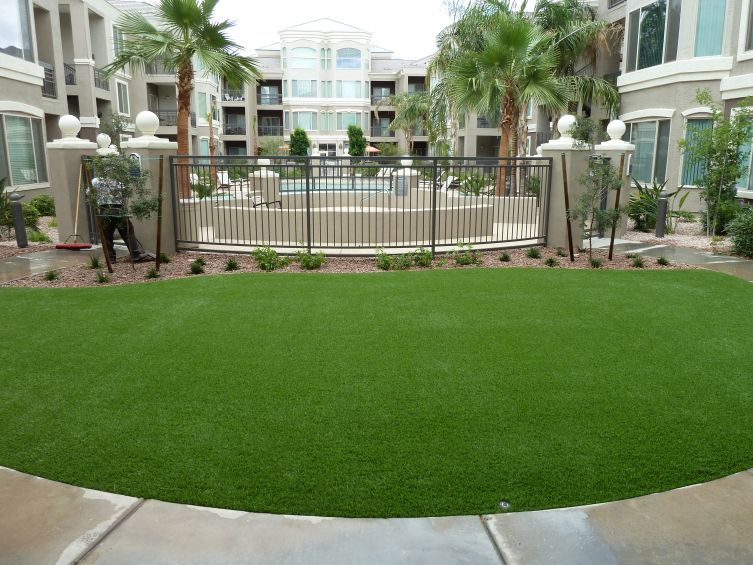
Artificial turf is not a luxury anymore. In the desert Southwest, it is one of the smartest financial decisions a homeowner can make, and the math has never been clearer.
What you are paying for now
A typical Arizona home with 1,000 sq ft of grass lawn spends between $1,200 and $1,800 every year just to keep it alive. Water bills, fertilizer, pest control, mowing services, and seasonal overseeding all add up fast. In the summer, that grass needs daily watering to survive triple-digit heat. Most of it still looks burned out by August.
That is before a single repair, resod, or irrigation system replacement. When you add those in over a five-year window, the average Arizona homeowner is spending $7,000 to $10,000 maintaining something green that is half-dead six months a year.
What synthetic turf actually costs
A quality synthetic turf installation for a 1,000 sq ft residential yard runs $8 to $14 per square foot installed, depending on product grade, infill type, and site prep. For most homeowners, total project cost lands between $9,000 and $14,000. For a yard-by-yard estimate, see our pricing guide. That sounds like a lot, until you run the five-year numbers against what you are already spending.
Annual savings breakdown (1,000 sq ft yard)
At $2,000 in annual savings on a $12,000 installation, a homeowner reaches full payback in roughly 6 years, then pockets $2,000 every year after for the remaining 14 to 18 years of product life. Total net benefit over product lifetime: $28,000+.
The factors that accelerate payback
Not every homeowner gets the same return. A few things meaningfully shorten or lengthen the timeline:
- Homes on tiered water rate schedules save more per gallon eliminated
- Properties with high HOA landscaping requirements see faster labor savings
- Yards with drainage problems or sloped terrain benefit from turf's drainage infill system
- Homes with pets save on lawn repair costs that compound year over year
- Families with children or frequent outdoor use extend the value of year-round usability
What it does for home value
Real estate data across the Phoenix metro shows curb appeal driven upgrades adding 5 to 15% to perceived property value at time of listing. Turf yards photograph well, require no buyer maintenance commitment, and are increasingly a selling point. In competitive markets like Scottsdale, Gilbert, and Chandler, a manicured synthetic lawn moves faster and often supports asking price.
In a dry climate where natural grass is visibly stressed by midsummer, synthetic turf is one of the few upgrades that improves both daily livability and resale positioning at the same time.
What it will not do
Turf does not eliminate all maintenance. It needs occasional rinsing, infill refreshing every few years, and regular pet waste cleanup. The upfront cost is real and requires planning. And lower-grade products installed without proper drainage and base prep will not perform for 20 years. Installation quality matters as much as product selection. If turf safety is also on your mind, read our honest look at PFAS and synthetic turf.
If a quote seems unusually low, ask about the base preparation spec and whether drainage infill is included. That is usually where budget installs cut corners.
Where your install dollars actually go
The per-square-foot price can look like a wide range until you see what drives it. Knowing the line items helps you compare quotes honestly instead of chasing the lowest number.
The base is the foundation of the whole system. A proper install excavates, grades, and compacts a crushed-rock base so the surface drains and never settles into ruts. Skipping this is the most common corner cut, and it is why a cheap lawn can look wavy within a year.
The turf itself varies by face weight, blade shape, and backing. Heavier, higher-quality products cost more up front and last longer, which is exactly the trade-off that protects your 15 to 20 year payback. Infill is the next variable, with options like silica sand or antimicrobial blends that affect feel, surface temperature, and odor control for pet owners.
Then there is the site itself. Tight access, removal of old grass and irrigation, drainage challenges, curves, and add-ons like a pet area or a chipping fringe all move the final number. A reputable installer prices these openly, so ask for the breakdown rather than a single lump figure.
A 10-year cost comparison, turf versus natural grass
Put the two side by side for a typical 1,000 square foot Phoenix yard and the picture gets clear fast. The number that matters is not the first invoice, it is the full decade.
Keep a natural grass lawn alive here and you spend roughly $1,500 a year on water, fertilizer, pest control, mowing, and overseeding. Over 10 years that is about $15,000, and that is before the irrigation repair or partial resod most yards need somewhere in that window. Call it $17,000 to $18,000 across the decade, and at the end you have nothing banked. The spending simply rolls into year 11.
Now run the turf side. A quality install lands around $12,000 one time. Upkeep is minor, occasional rinsing and an infill top-up every few years, realistically about $150 a year, or roughly $1,500 across the decade. Total 10-year cost: about $13,500. And unlike the grass, your turf is only about halfway through its usable life at that point.
So even by year 10 you are several thousand dollars ahead, and the gap only widens from there, because the grass bills never stop while the turf's biggest cost is already behind you. In a market with tiered water rates and triple-digit summers, that spread shows up faster than most homeowners expect.
A few situations widen the gap even further. Larger yards multiply the annual grass spend while a turf install scales more gently per square foot. Homes with dogs save on the patches, mud, and resodding that pets force on a living lawn. And properties under strict HOA landscaping rules avoid both the fines and the labor of keeping grass presentable through an Arizona August.
There is also the resale angle that never shows up on a utility bill. A clean, green, zero-maintenance yard photographs well and reads as move-in ready to buyers, which matters in competitive Valley markets. You are not only saving money year over year, you are protecting how the property shows the day you decide to sell.
Frequently asked questions
Is artificial turf worth it for an Arizona home?
For most Valley homeowners, yes. Between water savings, no lawn service, and no fertilizer or reseeding, a typical yard saves around $2,000 a year, which adds up fast against a one-time install. The desert climate makes the math especially favorable here.
How much does artificial turf cost in Arizona?
A quality install runs roughly $8 to $14 per square foot depending on product grade, infill, and site prep. For a yard-by-yard estimate, see our pricing guide or request a free on-site measure.
How long until synthetic turf pays for itself?
Most homeowners reach full payback in about 3 to 6 years, then bank the savings for the remaining product life. Tiered water rates, HOA landscaping costs, and pets all shorten that timeline.
Does artificial turf increase home value?
Phoenix-metro curb-appeal upgrades commonly add 5 to 15 percent to perceived value at listing, and a turf yard photographs well with no maintenance commitment for the buyer. In markets like Scottsdale, Gilbert, and Chandler it can help a home move faster.
How long does synthetic turf last in the Arizona sun?
A quality, UV-stable product over a properly prepped base typically performs for 15 to 20 years. Installation quality matters as much as the product, so ask about base prep and drainage infill.
Arizona Turf Masters has been installing synthetic turf in the Valley for over 20 years. We can walk through a site-specific ROI estimate for your property. No pressure, just numbers.
Request Your Free Quote →